
Final Briefs Filed at Appeals Court in Continuation of Janus v. AFSCME
The following article is from the National Right to Work Legal Defense Foundation’s bi-monthly Foundation Action Newsletter, September/October 2019 edition. To view other editions or to sign up for a free subscription, click here.
Foundation seeks first-in-nation appellate court ruling to order non-member dues refunded
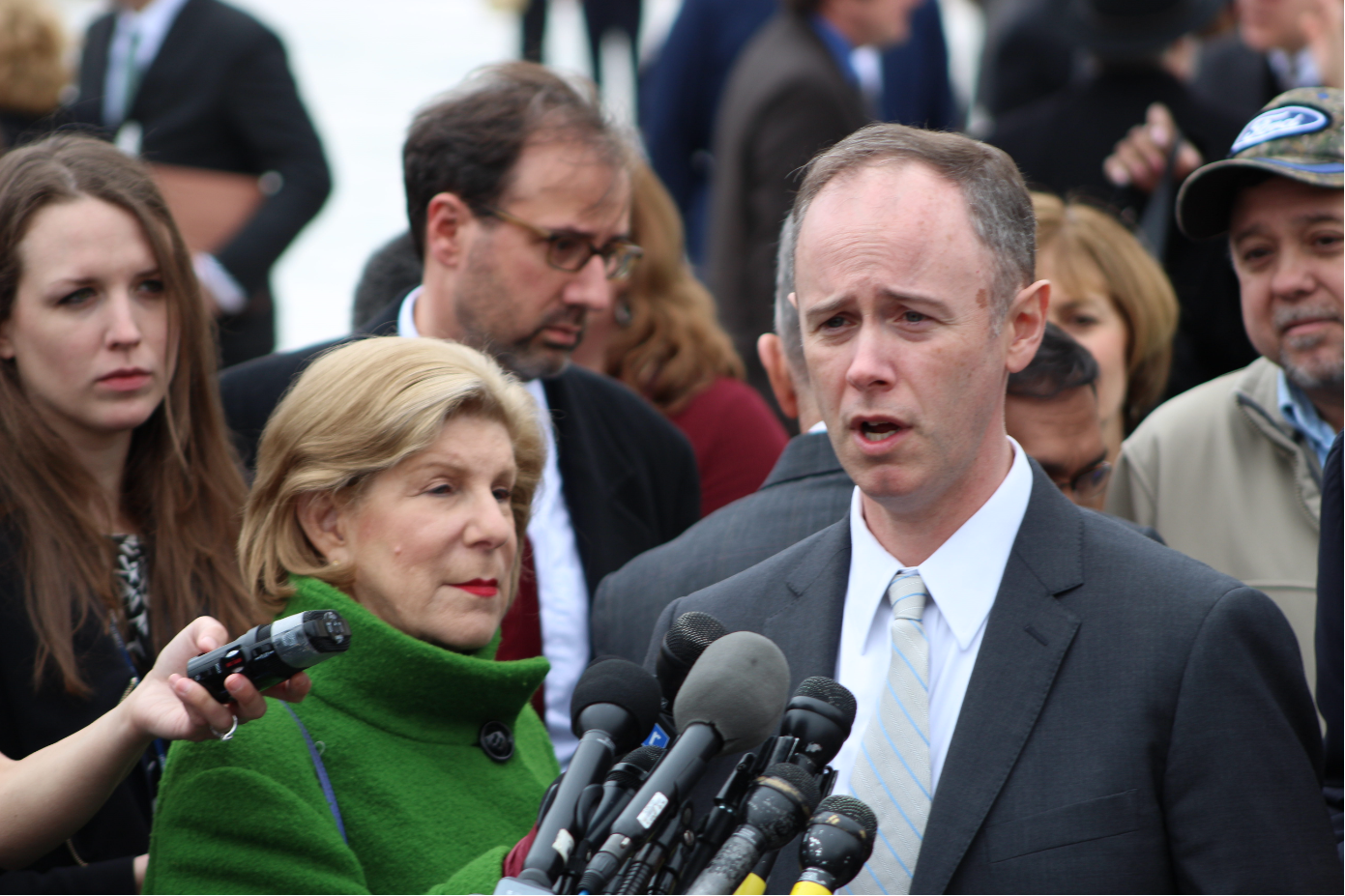
Veteran Foundation staff attorney William Messenger, seen here speaking to reporters after Supreme Court oral arguments in Janus, leads the Foundation’s Janus enforcement task force.
CHICAGO, IL – Although Janus v. AFSCME secured a landmark victory at the U.S. Supreme Court for government employees’ First Amendment rights, Mark Janus’ case is not over because AFSCME union bosses have refused to return the funds taken from him in violation of the First Amendment.
Janus’ attorneys from National Right to Work Foundation and Illinois-based Liberty Justice Center have completed briefing with the Seventh Circuit Court of Appeals on the issue of whether union officials can keep money they seized from non-members in violation of their constitutional rights. The case is likely to mark the first time an appellate court will rule on the issue, potentially establishing a precedent that could result in the return of hundreds of millions of dollars seized by union bosses in violation of the Janus precedent.
Janus Secured Workers’ First Amendment Rights
Mark Janus was an Illinois child support specialist whose case was successfully argued at the Supreme Court by National Right to Work Foundation staff attorney William Messenger.
The Supreme Court’s June 27, 2018, decision in Janus’ favor found that any union fees taken from workers like Mark Janus – who was not a member of AFSCME – without the workers’ affirmative and knowing consent violate the First Amendment. Justice Samuel Alito wrote for the majority that compulsory fees “[violate] the free speech rights of non-members by compelling them to subsidize private speech on matters of substantial public concern.”
The Supreme Court sent the case back to the lower courts to determine, among other things, whether Janus is entitled to all the union fees he was forced to pay since March 23, 2013.
Janus’ appeal comes after a district court judge ruled that union officials are not required to refund forced fees seized from non-member workers prior to the Janus decision.
“Just like a thief would not be allowed to keep the money he stole, union bosses must be forced to return funds unlawfully seized from workers,” said National Right to Work Foundation Vice President and Legal Director Ray LaJeunesse. “It would be a massive injustice to deny workers victimized by Big Labor the refunds to which the Supreme Court made clear they are entitled.”
Seventh Circuit Likely First Appeals Court to Rule on Non-member Refunds
Janus will likely be the first case in which an appellate court will evaluate the so-called “good faith” defense that union lawyers have asserted in response to worker lawsuits seeking refunds, arguing that union officials should be allowed to keep funds seized prior to the Janus decision.
This contention has generally succeeded in lower courts despite the Supreme Court asserting that union bosses have been “on notice” for years that mandatory fees likely would not comply with the heightened level of First Amendment scrutiny articulated in the Supreme Court’s earlier Knox v. SEIU decision, also won by Foundation staff attorneys.
Mark Janus is asking the Seventh Circuit to rule that he is entitled to refunds of approximately $3,000 in fees he was forced to pay since March 23, 2013, as the statute of limitations permits. In addition, the case has significant implications for dozens of other cases being litigated around the country for hundreds of thousands of other workers seeking the return of forced fees seized unlawfully by union officials.
Janus Refund Efforts Continue Nationwide
Foundation staff attorneys are currently litigating over a dozen such cases that collectively seek over $120 million in refunds for non-members forced to pay union fees before Janus. Other ongoing lawsuits and potential cases could result in half a billion dollars or more returned to government workers from union treasuries.
“The Janus case is a milestone of worker freedom, but union bosses continue to block workers from exercising their rights and deny workers refunds for dues and fees seized against their wishes,” said LaJeunesse. “We hope the Seventh Circuit Court of Appeals will follow the clear logic of the Supreme Court’s decision in Janus and establish that union bosses cannot profit from violating workers’ First Amendment rights.”
Illinois Care Providers Ask Supreme Court to Take Case Challenging Forced Union ‘Representation’ Law
Home and Childcare Providers ask the court to strike down unwanted ‘representation’ as a violation of the First Amendment
Washington, D.C. (June 6, 2017) – With free legal assistance from National Right to Work Legal Defense Foundation and the Illinois-based Liberty Justice Center staff attorneys, six personal care and child care providers today petitioned the Supreme Court to strike down a compulsory unionism scheme that grants Service Employees International Union (SEIU) officials exclusive monopoly “bargaining” powers with state government for thousands of Illinois caregivers – including many who never joined the union and oppose the union’s so-called ‘representation.’
In the brief, Foundation staff attorneys contend that the state law infringes on the providers’ First Amendment rights by forcing them to associate with a union they do not wish to join or support. Granting the union exclusive power to deal with the State of Illinois over caregiving practices violates the caregivers’ right to choose with whom they associate to petition their own government.
The caregiver’s petition to the Supreme Court in Hill, follows the Right to Work Foundation’s landmark 2014 Supreme Court victory in Harris v. Quinn, which was also filed on behalf of several home-based Illinois care providers. That decision prohibited union officials from collecting mandatory dues or fees from home-based caregivers.
The Hill petition argues that although the Harris case dealt with compelled fees, because the Court ruled that the state’s justification for mandatory fees was insufficient under the First Amendment, the Supreme Court should strike down the compelled association on the same grounds. The petition asks the Court to take the case so that it can apply the same standard to the First Amendment infringements created when state law forces home care providers to accept a government-appointed monopoly union agent against their will. Foundation staff attorneys have also helped home and childcare providers challenge similar schemes in Massachusetts, Minnesota, New York, Oregon, and Washington State.
“It is outrageous that across the country state laws force home and child care providers to accept unwanted ‘representation’ from a union they have no interest in joining or supporting,” commented Foundation President Mark Mix. “This is a clear violation of providers’ freedom of association and we are hopeful that this case will build on the Foundation’s landmark 2014 victory in Harris v. Quinn and end these corrupt forced unionism schemes for good.”
Illinois State Employee Asks U.S. Supreme Court to Hear First Amendment Challenge to Mandatory Union Fees
Janus v. AFSCME could free all government workers in the U.S. from being forced to pay union fees as a condition of employment
Washington, D.C. (June 6, 2017) – Today, the U.S. Supreme Court will be asked to hear a case that could free government workers from being forced to pay union dues or fees as a condition of employment.
Forcing government employees to pay money to union officials to keep their jobs violates the First Amendment, argues plaintiff Mark Janus in the case Janus v. AFSCME. Janus is a child support specialist from Illinois, whose lawsuit was brought by attorneys from the National Right to Work Legal Defense Foundation and the Liberty Justice Center.
The request for the U.S. Supreme Court to hear this case follows a March ruling by the U.S. Court of Appeals for the 7th Circuit, which upheld forced dues and fees based on the Supreme Court’s 1977 Abood v. Detroit Board of Education decision. The plaintiffs in Janus v. AFSCME argue that Abood was wrongly decided and should be overturned, especially in light of subsequent U.S. Supreme Court rulings that have applied strict scrutiny to mandatory union fees. A copy of the petition is available here.
Mark Mix, president of the National Right to Work Legal Defense Foundation, issued the following statement about the case:
“For too long, millions of workers across the nation have been forced to pay dues and fees into union coffers as a condition of working for their own government. Requiring public servants to subsidize union officials’ speech is incompatible with the First Amendment. This petition asks the Supreme Court to take up this case and revisit a nearly half-century-old mistake that led to an anomaly in First Amendment jurisprudence. By applying the principles the Court laid out in two recent cases brought for workers by National Right to Work Legal Defense Foundation staff attorneys – Knox and Harris – the Court can end the injustice of public sector forced dues by the end of next term.”
Jacob Huebert, senior attorney at the Liberty Justice Center, described what is at stake in the Janus case:
“People shouldn’t be forced to surrender their First Amendment right to decide for themselves what organizations they will and won’t support just because they decide to work for the state, their local government or a public school. This case gives the Supreme Court an opportunity to restore to millions of American workers the right to choose whether to support a union with their money.”
Mark Janus works for the Illinois Department of Healthcare and Family Services and is forced to send part of his paycheck to AFSCME. He said, explaining why he brought the case:
“I went into this line of work because I care about kids. But just because I care about kids doesn’t mean I also want to support a government union. Unfortunately, I have no choice. To keep my job at the state, I have to pay monthly fees to the American Federation of State, County and Municipal Employees, a public employee union that claims to ‘represent’ me. I’m filing this case on behalf of all government employees who want to serve their community or their state without having to pay a union first.”
In addition to Janus v. AFSCME, six other ongoing cases brought by workers with free legal assistance from the National Right to Work Legal Defense Foundation are challenging public sector forced dues. These cases represent the full spectrum of public employees, including teachers in Pennsylvania, school aides in Kentucky, university professors in Massachusetts, medical center technicians in California, school electricians in New York and state troopers in Connecticut.
Janus’ case is the first of that group to reach the Supreme Court. The case is on track for the Supreme Court to decide whether to hear it at its first conference of the term beginning in the fall. If four justices agree, the Supreme Court could announce soon after its September 25 conference that it will hear the case.
Background: Janus v. AFSCME’s journey to the Supreme Court
The case now called Janus v. AFSCME began on February 9, 2015. Illinois Gov. Bruce Rauner issued an executive order prohibiting state agencies from requiring nonmember state employees to pay union fees, and directed that instead any such fees deducted be put in escrow pending the resolution of litigation.
On the same day, Rauner filed a federal lawsuit in the U.S. District Court for the Northern District of Illinois against the collection of forced fees from state employees, asking for a declaratory judgment that the forced fee provisions violate the First Amendment and that his executive order was valid.
On March 23, 2015, staff attorneys from the National Right to Work Legal Defense Foundation and the Liberty Justice Center filed a motion for Mark Janus to intervene in the case. Janus’s complaint requested not only a declaratory judgment but also an injunction and damages from the unions for the compelled fees.
Although the court then ruled that Rauner did not have standing necessary to pursue his lawsuit, the challenge continued because the judge granted Janus’ motion to intervene. The case was renamed Janus v. AFSCME. On July 2, 2015, the Illinois Attorney General asked the district court to stay the case pending the Supreme Court’s decision in a case with similar constitutional issues at stake, Friedrichs v. California Teachers Association. The district court granted a stay on July 8, 2015.
According to most legal observers, the Supreme Court appeared ready to rule for the teacher plaintiffs in Friedrichs and declare that forced union fees for public sector workers violate the First Amendment. However, after Justice Antonin Scalia’s death in February 2016, the court ultimately deadlocked 4-4 on Friedrichs. Soon after, a district court judge dismissed Janus, allowing the case to be appealed to the 7th Circuit.
The appeal was filed in October 2016, and oral argument was held on March 1, 2017. On March 21, the 7th Circuit upheld the district court’s decision, ruling that the Abood v. Detroit Board of Education precedent applied to Janus v. AFSCME. That expected decision by the 7th Circuit allowed Janus’ attorneys to file a certiorari petition with the U.S. Supreme Court.
Recent Supreme Court victories set stage for Janus case
Janus follows a series of decisions that demonstrate a willingness by the Supreme Court to reconsider the constitutionality of forced union fees. In 1977, in Abood, the High Court had held that although union officials could not constitutionally spend objectors’ funds for some political and ideological activities, unions could require fees to subsidize collective bargaining and contract administration with government employers.
In the 2012 Knox v. SEIU case, brought by National Right to Work Legal Defense Foundation staff attorneys, the Supreme Court began to question Abood’s underpinnings. The Court there held that union officials must obtain affirmative consent from workers before using workers’ forced union fees for special assessments or dues increases that include union politicking.
In the opinion Justice Samuel Alito authored, the door was left open to challenge all forced union fees as a violation of the First Amendment. Alito wrote, “By allowing unions to collect any fees from nonmembers and by permitting unions to use opt-out rather than opt-in schemes when annual dues are billed, our cases have substantially impinged upon the First Amendment rights of nonmembers.” Additionally he said, “Unions have no constitutional entitlement to the fees of nonmember-employees.”
Two years later, the Foundation assisted a group of Illinois home care providers, including Pam Harris, a mother taking care of her disabled son, in challenging a state scheme authorizing Service Employees International Union officials to require the providers to pay union dues or fees. National Right to Work Legal Defense Foundation attorneys took the case to the Supreme Court, which held that the forced dues requirement violated the First Amendment. The Liberty Justice Center filed an amicus brief in support of Pam Harris and the other plaintiffs with the Supreme Court.
In its Harris ruling, the Court heavily criticized the reasoning of Abood and refused to extend Abood to the “new situation” before it, “[b]ecause of Abood’s questionable foundations, and because the personal assistants are quite different from full-fledged public employees.” The decision held Illinois’ scheme unconstitutional and cracked the door even further open for the Court to revisit Abood and the constitutionality of forced union fees. Justice Alito wrote for the Court, “Except perhaps in the rarest of circumstances, no person in this country may be compelled to subsidize speech by a third party that he or she does not wish to support.”
Last year, it appeared that the Supreme Court was ready to strike down forced union fees for public sector workers for good in the Friedrichs v. California Teachers Association case. The case was brought by Rebecca Friedrichs and eight other teachers who argued that Abood should be overturned because the forced collection of union fees is a violation of the First Amendment. In that case, attorneys for the Liberty Justice Center filed an amicus brief for Mark Janus and National Right to Work Legal Defense Foundation staff attorneys filed a separate amicus brief. Both asked that the High Court strike down compulsory union fees for public employees as a violation of the First Amendment.
Most legal observers agreed that Scalia was set to cast the deciding fifth vote in favor of the plaintiffs. However, his death just weeks before the case was to be decided resulted in a deadlocked court and left Abood in place for the time being. Now, Janus provides another vehicle for the Supreme Court to revisit the constitutionality of compelled union fees for public employees.





