
Austin Worker Files Federal Constitutional Challenge Against Biden-Harris Labor Board
National Labor Relations Board facing numerous worker-brought lawsuits citing unconstitutional structure
Fort Worth, TX (November 2, 2024) – Dallas Mudd, an employee of Aunt Bertha (d/b/a FindHelp), has launched a federal lawsuit against the National Labor Relations Board (NLRB) on the grounds that the agency’s structure violates the U.S. Constitution. National Right to Work Legal Defense Foundation staff attorneys representing Mudd filed the suit in the U.S. District Court for the Northern District of Texas. The lawsuit joins a string of cases challenging the NLRB’s structure on separation of powers principles.
Mudd’s case comes on the heels of his own employer’s suit against the NLRB. In that case, a federal district court judge ruled in favor of FindHelp and granted an injunction to halt proceedings against the company.
Mudd filed a decertificiation petition with the NLRB back in September, requesting a vote to remove the Office & Professional Employees International Union (OPEIU) from his workplace. Instead of allowing the vote to proceed, NLRB officials blocked the election, leaving the workers indefinitely trapped in a union they oppose. Mudd is appealing that decision to the full Board in Washington DC.
Mudd’s federal lawsuit argues he is entitled to have his appeal adjudicated before a federal agency that is accountable to the president. The case joins four other constitutional challenges to the NLRB’s structure from Foundation-backed rank-and-file workers, including the first-ever such lawsuit challenging NLRB Board Member removal protections, which is currently being briefed at the DC Circuit Court of Appeals by Foundation attorneys representing Buffalo, NY-based Starbucks employees Ariana Cortes and Logan Karam.
Mudd’s lawsuit points to recent Supreme Court rulings, including Seila Law LLC v. CFPB and Collins v. Yellen, which emphasized that the President has direct authority to remove executive officials who exercise significant authority. Mudd argues that the NLRB’s structure, as defined by the National Labor Relations Act (NLRA), places unlawful limitations on the president’s power to oust NLRB officials who exercise significant executive authority.
The complaint, filed in the U.S. District Court for the Northern District of Texas, joins a similar suit at the same court from Reed Busler. Similar to Mudd, Busler, a Starbucks employee, filed a petition asking the NLRB to hold a vote to remove the incumbent Starbucks Workers United (SBWU) union, only to have the vote blocked by NLRB officials. In all the cases the employees argue they are entitled to have their cases heard by Board officials who are not exercising powers in violation of the Constitution.
“Independent-minded workers should not be forced to depend on biased agencies staffed by bureaucrats, that exercise power in violation of the Constitution, just to free themselves of unwanted union affiliation,” said National Right to Work Foundation President Mark Mix. “The Constitution does not permit a powerful federal agency to operate as the judge, jury, and executioner without oversight, and these legal challenges seek to ensure that the Labor Board functions within the law, for the sake of all workers.”
After Janus, Foundation Continues Fight to Expand Freedom for Public Employees
The following article is from the National Right to Work Legal Defense Foundation’s bi-monthly Foundation Action Newsletter, September/October 2023 edition. To view other editions of Foundation Action or to sign up for a free subscription, click here.
Building off Janus, CUNY professors’ lawsuit could end forced ‘representation’ powers
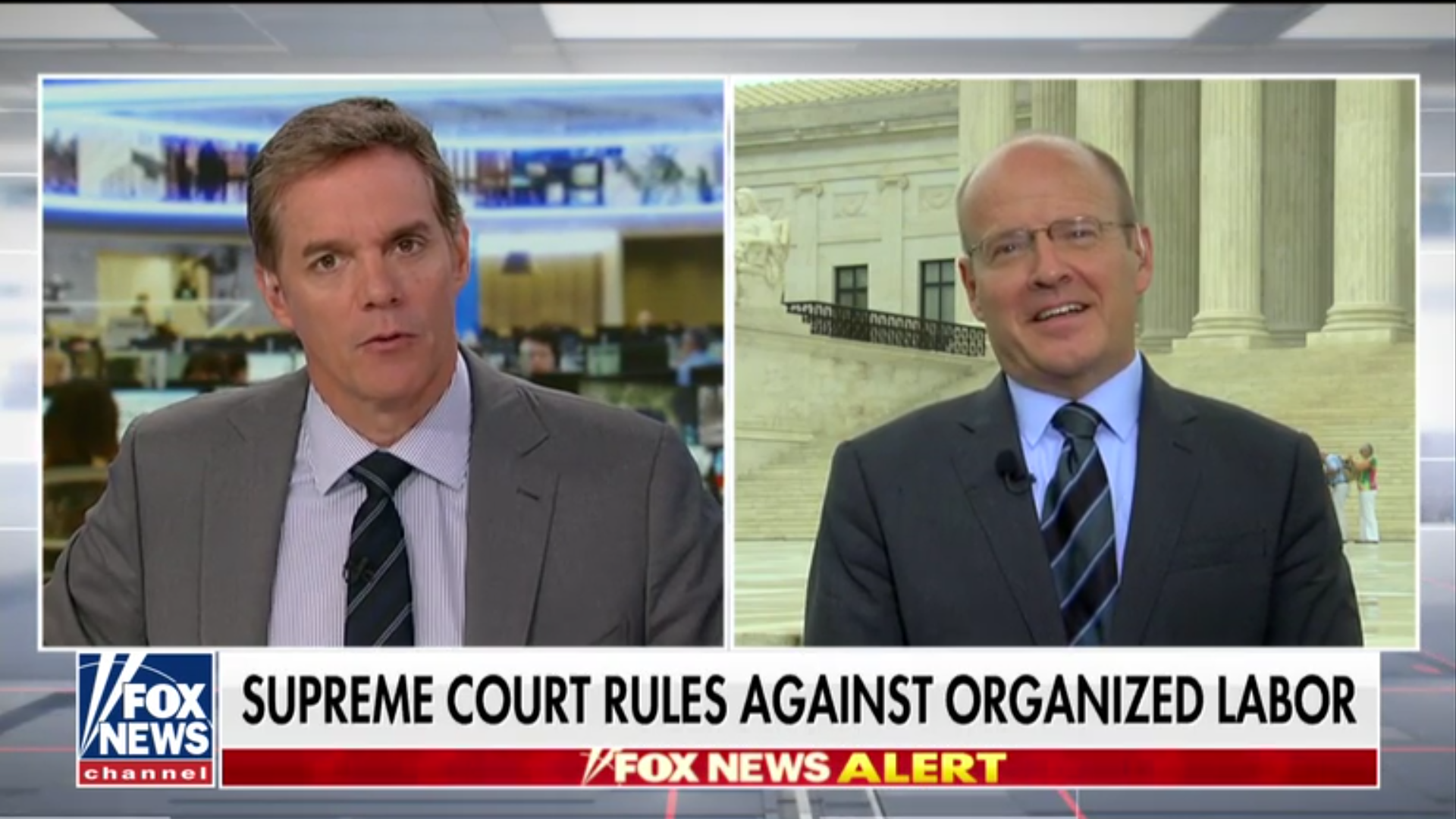
The Foundation’s historic Janus victory was a serious blow to public sector union bosses’ coercive power in its own right. But it also opened the door for efforts to free public workers completely from forced dues and forced representation.
NEW YORK, NY – Up until 2018, union bosses had the power to force millions of government workers to pay union dues or fees just to keep their jobs. While such an enormous privilege was not only a gross violation of workers’ free association rights, it also provided a steady stream of forced dues to union bosses, which contributed to their outsized influence over the government and our political system.
Union officials’ forced-dues power over public sector workers crumbled on June 27, 2018, when National Right to Work Foundation staff attorneys won the landmark Janus v. AFSCME decision at the U.S. Supreme Court. A majority of the Justices agreed with Foundation attorneys that every American public sector worker has a First Amendment right to abstain from paying dues to an unwanted union.
On the fifth anniversary of Janus, its impact can’t be overstated. Between the Janus decision itself and over 50 follow-up cases, Foundation staff attorneys have enforced the rights of over 500,000 employees nationwide. Meanwhile, studies find that independent-minded workers are withholding over $700 million in formerly mandatory dues and fees from public sector union bosses every year as a result of the decision.
Of course, Foundation staff attorneys continue to fight to defend, enforce, and expand on the landmark decision.
New Challenge to Forced ‘Representation’ Reaches Court of Appeals
In an ongoing Foundation-assisted case, Goldstein v. Professional Staff Congress (PSC), six City University of New York (CUNY) professors seek to knock down the final pillar of coercive union power in the public sector — union bosses’ power to force their one-size-fits=all “representation” on workers who don’t want it.
A brief recently filed at the Second Circuit Court of Appeals for the professors argues that PSC union officials are violating the professors’ First Amendment rights by forcing them to accept the union’s monopoly control and “representation.”
Professors’ Lawsuit: Janus Already Noted Dangers of Monopoly Bargaining
The professors have found the actions of PSC union bosses and adherents to be “anti-Semitic, anti-Jewish, and anti-Israel,” and have even reported union-instigated bullying and threats targeted against them.
The professors’ opening brief at the Second Circuit maintains that the Supreme Court already acknowledged in the Janus decision that public sector monopoly bargaining is “a significant impingement on associational freedoms,” and argues that New York State’s Taylor Law authorizes such bargaining in violation of workers’ rights.
“If the First Amendment prohibits anything, it prohibits the government from dictating who speaks for citizens in their relations with the government,” reads the brief.
The case, which will likely head to the U.S. Supreme Court no matter how the Circuit Court rules, could set a nationwide precedent forbidding public sector monopoly bargaining, just as Janus prohibits forced dues in all public sector workplaces. The combination of both Foundation-won precedents would guard public workers nationwide from both forced dues and forced representation.
Foundation Brief Defends State Law to Fortify Janus
The Janus victory also motivated freedom-loving state legislators to take extra measures to ensure workers’ First Amendment rights under Janus are being enforced.
In Indiana, a reform now forbids public employers from using taxpayer-funded government payroll systems to deduct union dues without a worker’s explicit consent. Public employers must obtain yearly consent from workers who wish to have union dues taken from their paychecks, and must also ensure that workers have notice of their constitutional right not to fund union activities. Unsurprisingly, dues-hungry Anderson Federation of Teachers (AFT) union officials sued the state to block these commonsense protections.
Foundation attorneys joined the fight recently to defend Indiana’s laws. A Foundation brief in the Seventh Circuit Court of Appeals urges the court to overturn a lower court’s injunction of these reforms, citing Seventh Circuit precedent.
Foundation attorneys helped successfully defend a similar law in West Virginia in 2021, which the West Virginia Supreme Court upheld on the basis that union bosses “have no constitutional entitlement to employees’ money or to the employer’s administration of union dues deduction schemes.”
Federal Courts Must End Union Monopolies
“Janus was a great triumph for American public workers’ freedom, but it was only a step toward the ultimate goal of freeing public workers from all unwanted union coercion,” commented National Right to Work Foundation Vice President Patrick Semmens. “No American worker should be forced to associate with union officials and union members that openly oppose their interests, including through attacks on their culture and religion as the plaintiffs in Goldstein have harrowingly experienced.”
“It’s encouraging to see that states like Indiana have stepped up to protect workers’ Janus rights,” Semmens added. “But ultimately, after recognizing in Janus and older precedents that union monopoly bargaining abridges workers’ free association rights, it’s high time for federal courts to end this enormous government-granted power for union bosses once and for all.”





