
Wisconsin Employee Files Class Action Lawsuit to Defend Wisconsin State Law That Guarantees Workplace Freedom
Suit: Outdated federal precedents wrongfully permit union officials to block workers from stopping union dues payments
Milwaukee, WI (September 18, 2026) – Caryn Johnson, an employee of Olympic Companies, has filed a new class action lawsuit against both International Union of Painters and Allied Trades (IUPAT) District Council 7 and her employer. The lawsuit states that the union and employer continue to deduct union dues from Johnson’s paycheck after she provided written notice of termination of her union membership, which violates Wisconsin state law.
The lawsuit was filed in the U.S. District Court for the Eastern District of Wisconsin with free legal aid from National Right to Work Foundation staff attorneys, and represents the latest in a line of violations that union officials have committed against Johnson. In June, Johnson and her Foundation staff attorneys filed charges at the National Labor Relations Board stating that union officials falsely claimed union membership was mandatory.
Johnson argues in the lawsuit that previous federal court decisions limiting Wisconsin’s state Right to Work protections were decided incorrectly, and that she and others in similar situations deserve the full workplace freedoms Wisconsin law provides.
Federal Courts Incorrectly Override State Laws Protecting Workers’ Right to Stop Union Dues
Wisconsin is a Right to Work state, meaning that employees such as Johnson are not required to join or pay dues to a union in order to get or keep a job. Wisconsin’s state Right to Work law is designed to be comprehensive, proactively guaranteeing that if an employee wants to stop payroll deductions of union dues, the employer must honor that request within 30 days.
This law should prevent union bosses in Wisconsin from imposing unilateral and arbitrary “window periods” to keep independent-minded employees from stopping dues payments except during a narrow time period established by union officials. However, in 2018, a divided panel of the U.S. Seventh Circuit Court of Appeals decided in Allen that Wisconsin’s state law was preempted by federal law, citing the 1971 Sea Pak Supreme Court decision.
In Johnson’s case, local IUPAT officials told her that she had to wait until a 10-day period in February 2027 to stop paying dues, despite the fact that Johnson was illegally coerced into the union in the first place and Wisconsin law protects her right to choose when to stop dues payments. Now, on behalf of other workers subject to the union’s arbitrary window periods, Johnson is arguing that Allen and Sea Pak were wrongly decided, and Wisconsin’s state law is a legitimate state protection for workplace freedoms.
Previously, the issue was presented to the U.S. Supreme Court in 2019 in the Allen case. However, Democrat Wisconsin Attorney General Josh Kaul, almost immediately after being elected, withdrew the state’s petition to the U.S. Supreme Court asking the High Court to review and overturn the Allen decision. Reports show union officials gave Kaul’s campaign hundreds of thousands of dollars in direct contributions, with union affiliates being his seven largest contributors.
“Wisconsin’s popular Right to Work law is designed to fully protect workers from being forced to pay union dues against their will, yet that right is being improperly limited by union officials using arbitrary ‘window periods’ to stifle workers’ attempts to stop dues,” commented National Right to Work Foundation President Mark Mix. “We are proud to assist Ms. Johnson as she fights for not only her own rights, but to defend the workplace freedoms of all Wisconsinites.”
Chicago 911 Operator Successfully Defends Janus Rights Against IBEW Forced Dues
The following article is from the National Right to Work Legal Defense Foundation’s bi-monthly Foundation Action Newsletter, September/October 2024 edition. To view other editions of Foundation Action or to sign up for a free subscription, click here.
Six years after Janus, union bosses still violating workers’ First Amendment rights, but workers fight back
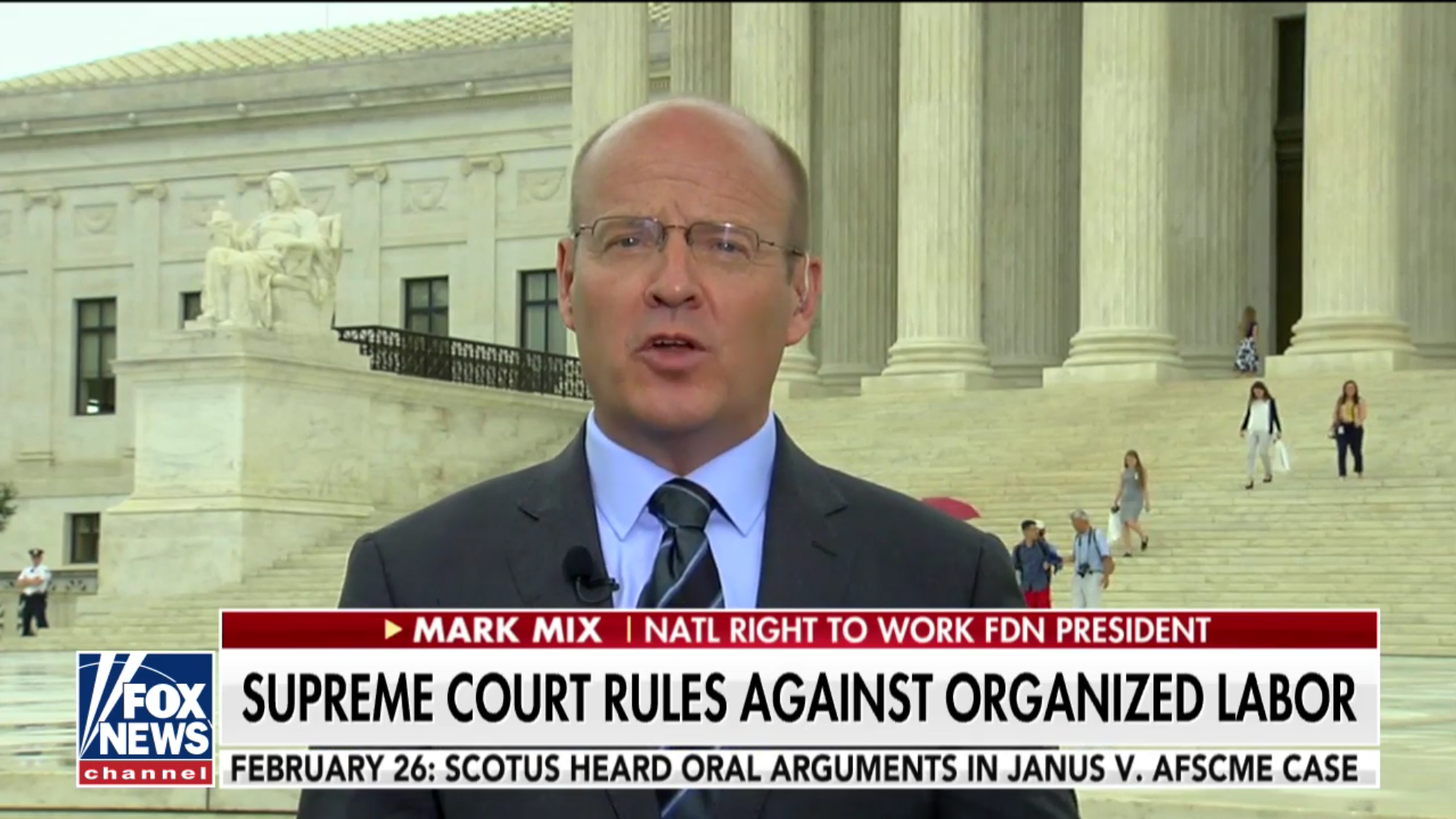
Hundreds of thousands of American public sector workers felt the impact of the Foundation-won Janus decision almost immediately after the Supreme Court decided it in June 2018, and its legacy has only continued to grow.
CHICAGO, IL – “I decided to leave [International Brotherhood of Electrical Workers (IBEW)] 21 because for some time now I believed that IBEW 21 was not acting in the best interest of its members. Be it a new job title that senior employees were deliberately misinformed about, to breach of contract on my employer’s part, to having to navigate the police and court alone after being threatened at work, IBEW 21 was either ineffective or absent.”
This is how Rhonda Younkins, a City of Chicago 911 operator, described the so-called “representation” she and her colleagues were getting from IBEW 21 union bosses. With free legal aid from the National Right to Work Foundation, Younkins in June was able to force IBEW Local 21 officials to return unlawfully deducted dues and cease future payroll deductions.
IBEW Bosses Backed Off Anti-Janus Demands After Foundation Involvement
Younkins was defending her rights under the landmark Foundation-won Janus v. AFSCME Supreme Court decision. In Janus, the justices ruled that the First Amendment forbids union bosses from forcing public sector workers to join or pay dues to a union as a condition of employment. The Justices further clarified that union officials could only take dues from a worker’s paycheck after receiving their clear and affirmative consent.
Younkins repeatedly tried to end dues payments to the IBEW 21 union, but union officials either ignored her requests or tried to foist other demands on her. After many unsuccessful attempts, Younkins sought free legal aid from Foundation staff attorneys, who filed charges against the IBEW union at the Illinois Labor Relations Board (ILRB).
IBEW 21 union officials eventually backed down, ceased dues collections, and issued refunds of past illegally seized dues.
Janus Impact Still Growing
While Younkins’ reasons for defunding IBEW union bosses are unique to her job and experience, she’s certainly not alone in using Janus to break free from union bosses’ influence. After Janus was issued in 2018, an estimated 450,000 public employees immediately stopped payment to unions, and in the six years since then, Foundation-backed litigation has helped defend the rights of tens of thousands of other government employees.
“We at the Foundation are encouraged at the strides workers have made since our Janus victory at the Supreme Court,” commented National Right to Work Foundation Vice President Patrick Semmens. “But the fight is far from over. As cases like Ms. Younkins’ show, union bosses still stonewall public workers when they try to exercise their First Amendment Janus freedoms, and private sector workers don’t yet enjoy similar protections.
“Foundation staff attorneys will keep fighting for a future where all American workers’ right to freely associate or dissociate with a union is fully protected,” Semmens added.





