
Puerto Rico Police Bureau Employees Foil Anti-Janus Scheme
The following article is from the National Right to Work Legal Defense Foundation’s bi-monthly Foundation Action Newsletter, November/December 2024 edition. To view other editions of Foundation Action or to sign up for a free subscription, click here.
Federal court strikes down discrimination against workers at the Puerto Rico Police Bureau who exercised First Amendment rights
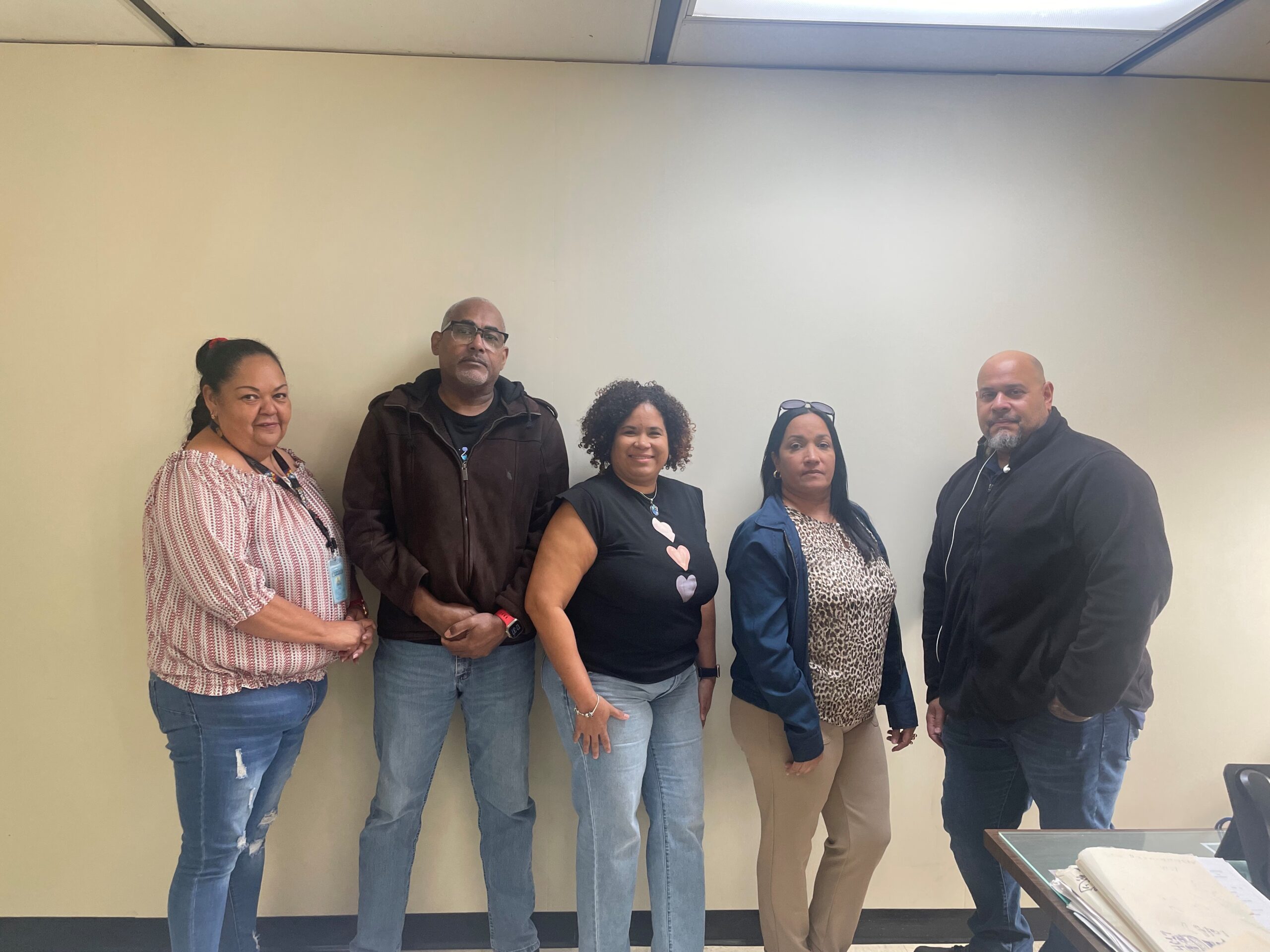
Vanessa Carbonell (center) and other employees of the Puerto Rico Police Bureau won big at the Puerto Rico District Court in September 2024. Their Foundation-won decision forces their employer and the union to stop violating their Janus rights.
SAN JUAN, PR – The National Right to Work Foundation’s 2018 victory at the U.S. Supreme Court in Janus v. AFSCME opened new horizons for employee freedom across the country. For the first time, the Justices recognized that the First Amendment prohibits union bosses from forcing public sector employees to join a union or pay dues as a condition of employment, and that union bosses can only take dues from a worker’s paycheck with their affirmative consent.
Foundation attorneys’ efforts to enforce the landmark decision yielded a big victory this September for a wide swath of civilian employees at the Puerto Rico Police Bureau (PRPB). In a class action federal lawsuit, more than a dozen PRPB employees charged officials of the Union of Organized Civilian Employees with violating their Janus rights by stripping them of an employer-provided health benefit because they refused to join the union.
A recent decision from the District Court of Puerto Rico found in favor of the employees’ arguments, stating that their employer had indeed taken away the health benefit because the employees exercised their right to not join or pay dues to the union.
Scheme Forced Workers to Join Union or Lose Access to Better Healthcare
“This is either retaliation for exercise of non-union members’ post-Janus non-associational rights under the First Amendment under the Constitution or simply discrimination,” said the Court.
According to lead plaintiff Vanessa Carbonell and her colleagues’ original lawsuit, they all exercised their Janus right to opt out of the union at various points after the 2018 Janus decision. They each began noticing that as dues ceased coming out of their paychecks, they also stopped receiving a $25-a-month employer-paid benefit intended to help employees pay for better health insurance.
The lawsuit demonstrated that PRPB officials cut the benefit off to employees who refused union membership — a clear case of discrimination against employees who exercise their First Amendment right to abstain from union affiliation.
Union and Employer Must Stop Discrimination
The District Court’s decision, in addition to declaring that the ploy by PRPB and the Union of Organized Civilian Employees is unconstitutional, orders an injunction to stop PRPB officials from continuing to withhold the benefit from Carbonell and other employees.
“Janus enshrined a very simple First Amendment principle: That union officials need to convince public employees to support their organization and activities voluntarily,” commented National Right to Work Foundation Vice President Patrick Semmens.
Former Connecticut State Trooper Wins Over $250,000 in Political Discrimination Suit
The following article is from the National Right to Work Legal Defense Foundation’s bi-monthly Foundation Action Newsletter, July/August 2023 edition. To view other editions of Foundation Action or to sign up for a free subscription, click here.
CSPU union upended trooper’s career after he refused to fund union politics

Joseph Mercer fought back with free Foundation legal aid when the CSPU union blocked his promotion because he challenged union political activities and told others about their rights.
HARTFORD, CT – In 2015, then-Connecticut State Trooper Joseph Mercer received a promotion to Operations Sergeant of the Emergency Services Unit, a position that gave him significant responsibility over emergency services training and field operations. Mercer gained this prestigious position through his seventeen years of experience as a trooper, which included a tense situation with an armed suspect barricaded in a hotel.
But behind the scenes, Mercer was a target of Connecticut State Police Union (CSPU) officials, who resented Mercer because of his resistance to funding union politics with his own money. After CSPU President Andrew Matthews filed two baseless grievances against Mercer, the Department of Emergency Services and Public Protection (DESPP) demoted him to a position that offered fewer overtime opportunities and involved less time in the field.
Mercer slammed CSPU and DESPP officials with a federal lawsuit in 2016 with free legal aid from the National Right to Work Foundation, accusing police union officials of retaliating against him for exercising his right to stop funding union politics.
This April, Foundation attorneys forced CSPU and DESPP to back down and settle the case. Both parties must now pay $260,500 as a condition of ending the suit.
CSPU Union President Targeted Dissident Trooper Immediately After Promotion
Just a month after Mercer received his promotion, CSPU President Matthews filed a grievance over Sergeant Mercer’s appointment.
Matthews’ grievance claimed that there had been no “selection process” to fill the position, despite the fact that none of Sergeant Mercer’s union-member predecessors had undergone any particular kind of selection process before they got the job. Matthews also filed a second baseless grievance, alleging Mercer had mismanaged the incident involving the armed suspect barricaded in a hotel. State police officials had never expressed dissatisfaction with how Mercer handled the situation.
In October 2015, after meeting in private with the union president, then-DESPP Commissioner Dora Schriro transferred Mercer out of his Operations Sergeant position to an administrative post. Prior to this demotion, Mercer had received no warnings, reprimands, or other disciplinary actions regarding the incident referenced in Matthews’ grievance. Mercer filed his lawsuit with Foundation aid in February 2016.
Mercer’s Foundation attorneys cranked up the heat on both the union and DESPP officials in May 2022, when a District Court judge ordered DESPP Commissioner James Rovella, who had replaced Schriro, to turn over additional documents that might provide insight into the circumstances surrounding Mercer’s firing.
Rather than follow through with the judge’s discovery order and continue the fight against Mercer, CSPU and DESPP reversed course and settled the case in April 2023. The settlement categorizes the vast majority of the $260,500 payout as “compensatory damages” due directly to Mercer.
Settlement Underscores Importance of Public Servants’ Janus Rights
“We are proud to have defended Sergeant Mercer’s rights and secured him a settlement that vindicates his free association,” commented National Right to Work Foundation Vice President and Legal Director William Messenger. “However, it’s disgraceful that CSPU union officials targeted Mercer, a dedicated public safety officer, with such a retribution scheme in the first place. Public servants should not have to endure multi-year lawsuits just so they can refrain from supporting union politics they oppose.”
“Situations like these demonstrate why the Foundation-won Janus v. AFSCME decision, which the U.S. Supreme Court decided while Mercer’s case was ongoing, is so important,” Messenger added. “As demonstrated in Mercer’s case, unelected union officials often wield their enormous clout over government to serve the union’s self interests over the public interest and employee interests. That’s why it’s vital that public employees can exercise their First Amendment Janus right to cut off all financial support for union officials this way.”
District Court Orders Connecticut State Police to Turn Over Evidence in Former Sergeant’s Retaliation Suit
Veteran officer was transferred out of prestigious position for asserting his workplace rights, choosing not to be a union member
Hartford, CT (May 27, 2022) – A federal judge has just ordered Connecticut Department of Emergency Services and Public Protection Commissioner James Rovella to turn over evidence in a federal retaliation lawsuit filed in 2016 by Joseph Mercer, a former Connecticut State Trooper.
Mercer, who is represented for free by National Right to Work Legal Defense Foundation staff attorneys, charged Connecticut State Police Union (CSPU) and state officials with knocking him out of a prestigious command position because he exercised his First Amendment rights to refrain from union membership and oppose the union’s political activity.
The U.S. District Court for the District of Connecticut ordered Rovella to turn over certain documents relevant to Mercer’s claims. According to the orders, these documents could be relevant to determining whether union and state police officials treated Mercer unfairly because he dissociated from CSPU.
Union Officials Fought to Remove Union Opponent from Prestigious Position He Was Qualified For
Mercer, a former state trooper, says he was transferred from his command position with the Emergency Services Unit because he resigned from the union and refrained from supporting its political agenda.
In May 2015, Sergeant Mercer was appointed Operations Sergeant of the Emergency Services Unit, a prestigious command position that entails significant responsibility for Emergency Services training and field operations. Although Sergeant Mercer had seventeen years of experience, in June 2015, CSPU President Andrew Matthews filed a grievance over Sergeant Mercer’s appointment.
Matthews’ grievance claimed that there had been no “selection process” to fill the position, despite the fact that none of Sergeant Mercer’s union-member predecessors had undergone any particular kind of selection process before they got the job.
Mathews also filed a second grievance, alleging Mercer had mismanaged a shooting incident involving an armed suspect barricaded in a hotel. State police officials never expressed dissatisfaction with how Mercer handled the situation.
In October 2015, the then-Commissioner of the Department of Emergency Services transferred Mercer out of his Operations Sergeant position to an administrative post. That new position gave Mercer substantially fewer opportunities to work in the field or accrue overtime pay. Prior to this demotion, Mercer had received no warnings, reprimands, or other disciplinary actions regarding the incident referenced in Matthews’ grievance.
Mercer’s lawsuit seeks his reinstatement as Operations Sergeant in the Emergency Services Division and compensatory damages for the decrease in his overtime pay opportunities. In August 2018, the District Court denied motions to dismiss the case filed by CSPU and state officials, allowing the case to proceed.
Evidence Revealing Unfair Treatment of State Trooper Must Be Handed Over
The court orders compelling discovery state that records about Emergency Services Unit team members in similar “deadly force” situations to Mercer’s “are relevant for the purpose of determining a central issue in the case: whether Plaintiff was treated differently by his employer than others in similar situations.” The orders also say that information concerning whether or not a “selection process” was used to fill the Operations Sergeant position clearly “pertain to the issue of whether Plaintiff was treated differently with respect to his appointment as Operations Supervisor.”
“By compelling discovery in this case, the District Court brings Sergeant Mercer one step closer to defeating openly vindictive and unconstitutional behavior by CSPU union officials and their allies in state government. They wreaked havoc on Mercer’s career simply because he disagreed with the union’s politics,” commented National Right to Work Foundation President Mark Mix. “We’ve been proud to fight alongside Sergeant Mercer the past few years and will continue to do so until his rights and career are restored.”
Federal Judge Rejects Attempt by TWU Union and Southwest to Thwart Flight Attendant’s Religious Discrimination Suit
Flight attendant’s case will go to trial at District Court in Dallas
Dallas, TX (May 10, 2022) – A federal judge has ruled that Southwest flight attendant Charlene Carter’s federal lawsuit, in which she is suing Transportation Workers Union of America (TWU) Local 556 officials and Southwest for illegally firing her over her religious opposition to abortion, will continue at the US District Court in Dallas. Carter is receiving free legal representation from National Right to Work Legal Defense Foundation staff attorneys.
District Court Judge Brantley Starr ruled late last week denying the TWU union’s and Southwest Airlines’ motions for summary judgment, which would have given the union and airline an early victory in the case. Starr affirmed in the decision that the case must move to trial because “genuine disputes of material fact preclude summary judgment” on all claims.
Flight Attendant Called Out Union Officials for Their Political Activities
As a Southwest employee, Carter joined TWU Local 556 in September 1996. A pro-life Christian, she resigned her membership in September 2013 after learning that her union dues were being used to promote social causes that violate her conscience and religious beliefs.
Carter resigned from union membership but was still forced to pay fees to TWU Local 556 as a condition of her employment. State Right to Work laws do not protect her from forced union fees because airline and railway employees are covered by the federal Railway Labor Act (RLA). The RLA allows union officials to have a worker fired for refusing to pay union dues or fees. But it does protect the rights of employees to remain nonmembers of the union, to criticize the union and its leadership, and advocate for changing the union’s current leadership.
In January 2017, Carter learned that Audrey Stone, the union president, and other TWU Local 556 officials used union dues to attend the “Women’s March on Washington D.C.,” which was sponsored by political groups she opposed, including Planned Parenthood. Carter’s lawsuit alleges that Southwest knew of the TWU Local 556 activities and participation in the Women’s March and helped accommodate TWU Local 556 members wishing to attend the March by allowing them to give their work shifts to other employees not attending that protest.
Carter, a vocal critic of Stone and the union, took to social media to challenge Stone’s leadership and to express support for a recall effort that would remove Stone from power. Carter also sent Stone a message affirming her commitment to both the recall effort and a National Right to Work law after union officials sent an email to employees telling them to oppose Right to Work.
After sending Stone that email, Carter was notified by Southwest managers that they needed to have a mandatory meeting as soon as possible about “Facebook posts they had seen.” During this meeting, Southwest presented Carter screenshots of her pro-life posts and messages and questioned why she made them.
Carter explained her religious beliefs and opposition to the union’s political activities. Carter said that, by participating in the Women’s March, President Stone and TWU Local 556 members purported to be representing all Southwest flight attendants. Southwest authorities told Carter that President Stone claimed to be harassed by Carter’s messages. A week after this meeting, Southwest fired Carter.
In 2017, Carter filed her federal lawsuit with help from Foundation staff attorneys to challenge the firing as an abuse of her rights, alleging she lost her job because of her religious beliefs, standing up to TWU Local 556 officials, and criticizing the union’s political activities and how it spent employees’ dues and fees.
Federal Judge: Flight Attendant’s Claims Against Southwest and Union Should Go to Trial
Notably, the District Court’s decision tosses arguments made by Southwest’s lawyers that Carter lacks a “private right of action” to enforce her fights under the Railway Labor Act (RLA), and arguments that her case concerned only a “minor” dispute over interpretation of the union contract that is outside the purview of the District Court.
The District Court’s ruling instead recognizes that the RLA’s explicit protection for employees’ free association rights means that Carter, who was fired for opposing the union based on its politics, “does have a private right of action” under the RLA.
The District Court re-affirmed its prior ruling that classifying the suit as a “minor dispute” is inappropriate, because “Carter had plausibly alleged that she engaged in protected speech and activity” and those claims “do not rest on and require interpretation of the collective bargaining agreement.”.
“[H]aving determined that Carter has a private right of action under [the RLA] and that this case concerns a major dispute,” the court ruled that a genuine dispute of material fact precludes summary judgment on this claim.
The decision also rejects an argument by Southwest and the union that the District Court is bound by an arbitrator’s findings. Such “issue preclusion” is inappropriate in this case because, while arbitrators are competent to resolve factual questions, they are “not competent to resolve the ultimate legal questions of a case,” the decision says.
“This decision is an important step towards long overdue justice for Charlene. The ruling rejects several attempts by Southwest and union officials to deny Ms. Carter’s right to bring this case in federal court and enforce her RLA-protected speech and association rights,” commented National Right to Work Foundation President Mark Mix. “Further, the decision acknowledges that, at its core, this case is about an individual worker’s right to object to how forced union dues and fees are spent by union officials to take positions that are completely contrary to the beliefs of many workers forced under the union’s so-called ‘representation.’”
“The Foundation is proud to stand with Charlene Carter and will continue fighting for her rights for as long as is necessary,” Mix added.





