
Federal Lawsuit Hits Guards Union of America for Illegally Forcing DC-Based Security Guard to Pay for Union Politics
Union officials provided contradictory information on amount a guard must pay the union to keep a job
Washington, DC (April 19, 2024) – Rosa Crawley, a DC-based security guard employed by Master Security, has just hit the International Guards Union of America (IGUA) Local 160 with a federal lawsuit, which maintains that full union dues, including dues for union political activities, are being illegally deducted from her paycheck. Crawley filed the complaint in the U.S. District Court for the District of Columbia with free legal aid from National Right to Work Foundation staff attorneys.
Crawley, who with her coworkers provides security services to the Department of Homeland Security’s “Nebraska Avenue Complex,” seeks to enforce her rights under the 1988 Right to Work Foundation-won CWA v. Beck Supreme Court decision. The Court held in Beck that union officials cannot force workers who have abstained from union membership to pay union dues or fees for any expenses not directly germane to contract negotiations. Nonmember workers who exercise their Beck rights are also entitled to an independent audit of the union’s finances and a breakdown of how union officials spend forced contributions.
Beck rights are only relevant in non-Right to Work jurisdictions like the District of Columbia, where union officials have the legal prvivilege to force private sector workers to pay dues or fees as a condition of getting or keeping a job. In jurisdictions that have Right to Work protections, like neighboring Virginia, union membership and all union financial support are strictly voluntary.
“I shouldn’t have to pay for the IGUA union’s political activity just so I can continue to do my job,” commented Crawley. “Union officials have a legal obligation to stop charging me for politics and provide me with an accounting of how they are using my money, and so far they have done neither. This isn’t how they should treat the workers they say they ‘represent.’”
Union Officials Haven’t Revealed How They Spend Worker Money
According to the suit, Crawley sent a letter to union officials resigning her union membership back in July 2023. Instead of immediately providing her with her Beck rights, union officials informed her that she would be charged a so-called “agency fee” which “is the same exact cost as what the union members pay.”
“So there will be absolutely no change in a financial sense,” the union’s reply letter stated.
Not satisfied with that explanation, Crawley in September 2023 formally invoked her Beck rights and asked union officials to reduce her dues payments in accordance with the decision. She also asked them to “provide [her] with an accounting, by an independent certified public accountant, that justifies Local 160’s calculation of its agency [forced] fee,” according to her lawsuit. In an October 2023 reply to her Beck request, union officials used a confusing percentage averaging calculation to determine a fee amount that contradicted what they told Crawley when she resigned her membership. An independent audit of the union’s finances was nowhere to be found.
Crawley’s lawsuit recounts that, since October 2023, union officials have made her reiterate her request for an accounting, pay an initiation fee equal to the initiation fee paid by full members, and “[have] collected and [continue] to collect from Crawley amounts equal to full union dues.”
“Federal labor law’s default position is that union officials are empowered to demand workers’ hard-earned money as a condition of employment. This is problematic because there are any number of reasons workers may not want to support the union, including religious, political, or financial reasons,” observed National Right to Work Foundation President Mark Mix. “While the Beck decision provides important protections, a Right to Work environment is ultimately better because workers are completely free to decide whether or not union officials deserve any of their hard-earned money.”
Foundation Lawsuit: Biden NLRB Structure Violates the U.S. Constitution
The following article is from the National Right to Work Legal Defense Foundation’s bi-monthly Foundation Action Newsletter, November/December 2023 edition. To view other editions of Foundation Action or to sign up for a free subscription, click here.
Groundbreaking suit filed for Starbucks employee who was denied vote to oust unwanted union bosses
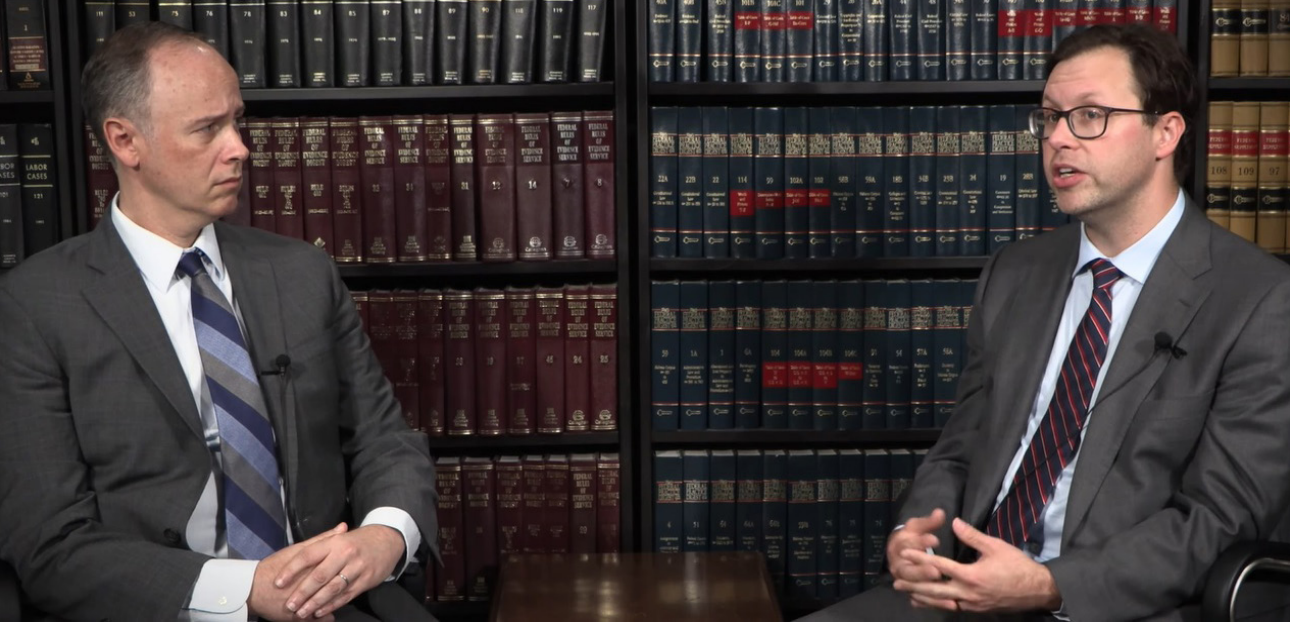
Starbucks employee Ariana Cortes’ Foundation attorney, Aaron Solem (right), is making a cutting-edge argument targeting the NLRB’s lack of accountability.
WASHINGTON, DC – The National Labor Relations Board (NLRB) is supposed to protect the right of workers to freely choose whether to associate with a union or not. The NLRB is also charged with holding unions and employers accountable when they violate worker rights. Too often, however, it has simply acted as an agency that generates policies to entrench union bosses’ power over workers while shielding union bosses from any kind of liability.
A new federal lawsuit from a National Right to Work Foundation-backed Starbucks employee, currently pending at the D.C. District Court, could upend the federal agency and result in a ruling that the current Labor Board’s structure violates the Constitution.
Employee Challenges NLRB Bureaucrats’ Protections from Presidential Removal
Ariana Cortes, a worker at the Buffalo, NY, “Del-Chip” Starbucks branch, hit the NLRB with the groundbreaking lawsuit in October, contending that the federal agency’s current structure violates the separation of powers mandated by the Constitution.
Cortes’ suit follows Foundation attorneys’ defense of her and her coworkers’ petition requesting a vote to remove Starbucks Workers United (SBWU) union officials from their workplace. Regional NLRB officials dismissed Cortes’ majority-backed petition based on SBWU allegations against Starbucks management that have no proven connection to Cortes and her coworkers’ desire for a union decertification vote.
Cortes’ lawsuit argues that because NLRB members cannot be removed at-will by the President, the NLRB’s structure violates Article II of the Constitution. Under Article II, the lawsuit contends, the President must have the power to remove officials that exercise substantial executive power.
Because the NLRB enforces federal labor law, manages union elections, and can issue legally binding rules and regulations, the lawsuit contends that the agency exercises substantial executive power. Therefore, it falls within the scope of the President’s power to remove officials at will. However, the National Labor Relations Act (NLRA), the law that established the NLRB, restricts the President’s ability to remove Board members except for neglect of duty or malfeasance.
“[T]hese restrictions are impermissible limitations on the President’s ability to remove Board members and violate the Constitution’s separation of powers. Thus, the Board, as currently constituted, is unconstitutional,” the complaint states.
Lawsuit: Unconstitutional NLRB Proceedings Must Stop
Cortes’ new federal lawsuit seeks a declaration from the District Court that the structure of the NLRB as it currently exists is unconstitutional.
“For too long the NLRB, especially the current Board, has operated as a union boss-friendly kangaroo court, complete with powerful bureaucrats who exercise unaccountable power in violation of the Constitution,” commented National Right to Work Foundation Vice President and Legal Director William Messenger. “The NLRB’s operation outside constitutional norms is easily exploited by Big Labor.”
“But as the story of Ms. Cortes shows, the NLRB’s unchecked power creates real harms for workers’ rights, especially when workers seek to free themselves from the control of union bosses they disagree with,” Messenger added.





