
Starbucks Employees File Brief with Appeals Court in Case Challenging Constitutionality of Labor Board Structure
NY Starbucks workers are challenging NLRB that refuses to hold votes to remove unwanted SBWU union
Washington D.C. (October 16 2024) – New York Starbucks employees Ariana Cortes and Logan Karam have filed the opening brief with the D.C. Circuit Court of Appeals in their groundbreaking lawsuit challenging the structure of the National Labor Relations Board (NLRB) as unconstitutional. The lawsuit, initially filed by Cortes, and later joined by Karam, follows NLRB officials’ refusal to process their respective petitions requesting a vote to remove Starbucks Workers United (SBWU) union officials from their workplace.
The lawsuit states that the National Labor Relations Act of 1935 (NLRA) violates Article II of the Constitution by shielding NLRB Board Members from being removed at the discretion of the president. The appeal challenges a District Court decision that dismissed the lawsuit on the grounds that the plaintiffs lack legal standing. That decision did not address the underlying claim regarding whether the Labor Board’s structure complies with the requirements of the Constitution.
The brief, filed with free legal aid from the National Right to Work Legal Defense Foundation, thoroughly refutes the District Courts decision that Cortes and Karams lack standing to challenge the constitutionality of the Board, and also argues why the Court should side with the plaintiffs on the merits of their constitutional challenge against the NLRB.
Starbucks Employees Are Being Denied Their Right to Vote
On April 28, 2023, Cortes submitted a petition, supported by a majority of her colleagues, asking the NLRB to hold a decertification election at her Buffalo-area “Del-Chip” Starbucks store to remove SBWU union officials’ bargaining powers over workers. However, NLRB Region 3 rejected Cortes’ petition, citing unfair labor practice accusations made by SBWU union officials against the Starbucks Corporation. Notably, there was no established link between these allegations and the employees’ decertification request.
Similarly, Karam filed a decertification petition seeking a vote to remove the union at his Buffalo-area Starbucks store. Like Cortes’ petition, NLRB officials refuse to allow the vote to take place, citing claims made by SBWU officials. As a result the workers remain trapped under union “representation” they oppose.
“The lower court’s decision was wrong in finding that Cortes’ and Karam’s case lacked standing, as both have business before the NLRB right now and also did at the time their lawsuit was filed,” commented National Right to Work Foundation President Mark Mix. “We’re hopeful that the D.C. Court of Appeals will agree, and sides with these workers who are entitled to have their decertification case adjudicated by a Labor Board whose structure complies with the Constitution.”
“Despite the wishes of Big Labor and the NLRB who appear intent on squashing the rights of workers opposed to unionization and exercising unfettered power, federal labor law is not exempt from the requirements of the highest law of the land,” added Mix.
Buffalo Starbucks Barista Counters NLRB’s Move to Trap Workers in Union
The following article is from the National Right to Work Legal Defense Foundation’s bi-monthly Foundation Action Newsletter, January/February 2024 edition. To view other editions of Foundation Action or to sign up for a free subscription, click here.
Appeals Court brief defends workers’ right to oppose and decertify union
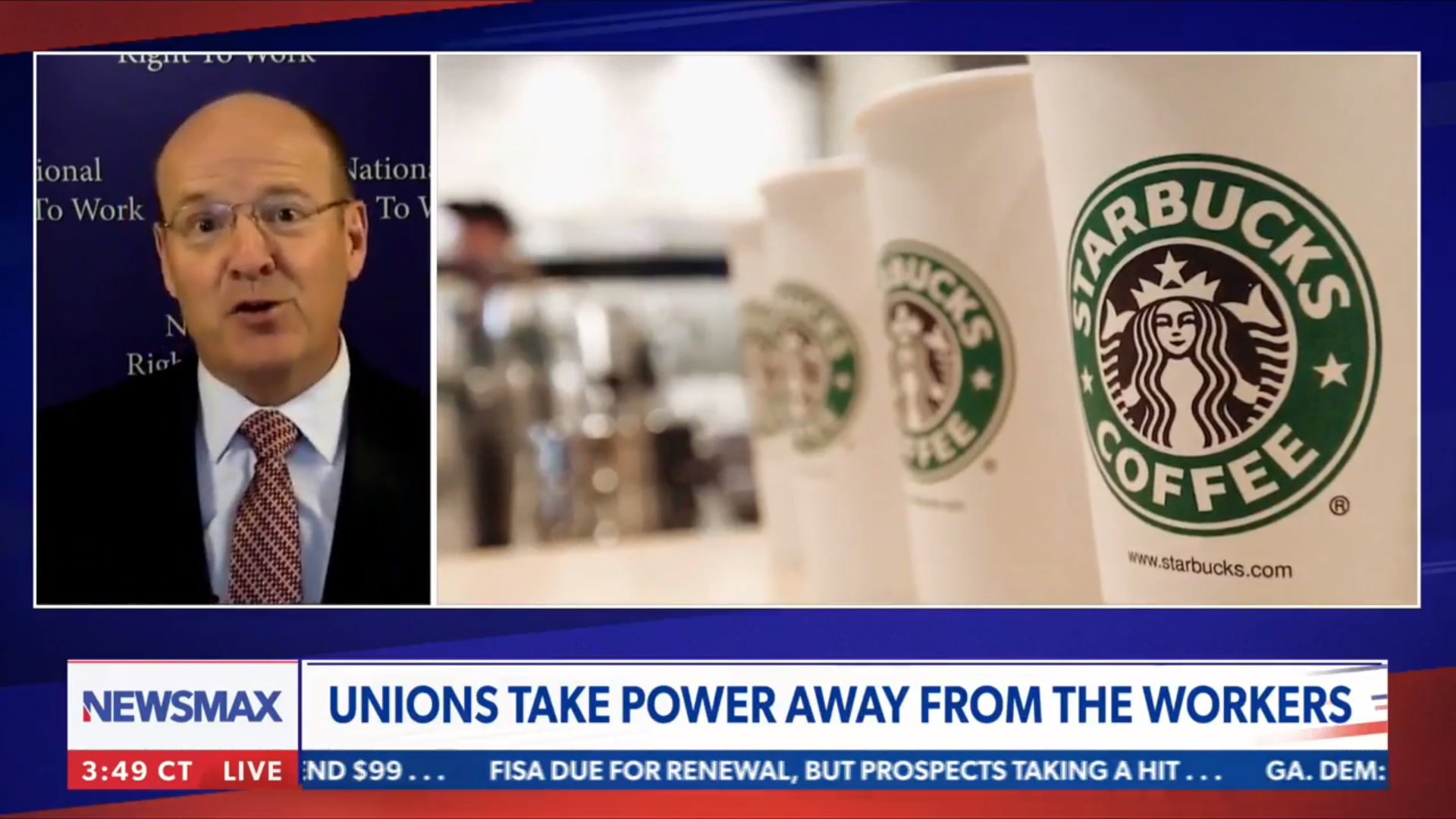
As Mark Mix explained on Newsmax TV, SBWU officials spent millions to infiltrate Starbucks with covert union agitators. That led to some of the first unionized Starbucks stores in Buffalo, NY, but now Buffalo baristas are trying to oust SBWU.
BUFFALO, NY – Although the National Labor Relations Board (NLRB) is charged with neutrally enforcing federal labor law, it has a notorious reputation for strengthening union officials’ power while diminishing the rights of workers opposed to union representation. Even with this biased history, the Biden Labor Board has already established itself as the most radically pro-forced unionism board in history.
The NLRB’s ideological bias is most apparent in its massive campaign to impose coercive unionism on Starbucks workers, while repeatedly blocking and undermining Starbucks employees’ attempts to remove unwanted union representation. While agency officials have approved hundreds of petitions for votes to bring the Starbucks Workers United (SBWU) union in, it has not let any of the roughly 20 worker-backed petitions seeking votes to remove the union advance to an election.
NLRB Cites Workers’ Desire to Oust Union as Reason to Impose Union
The NLRB’s anti-worker tactics have reached a new frontier. The NLRB is now citing a petition to remove the union as a reason why the union should not be removed and should serve as the basis for an injunction against Starbucks. NLRB lawyers are asking the Second Circuit Court of Appeals to overturn a District Court ruling and issue an injunction that would force Starbucks to engage in bargaining talks with the union, despite the fact that the decertification petition proves that a majority of employees at a Buffalo, NY, Starbucks want to throw the union out.
The decertification petition in question was collected by Starbucks barista Ariana Cortes. Cortes sought a vote to remove SBWU from her workplace, but the NLRB has refused to conduct the election. National Right to Work Legal Defense Foundation staff attorneys represent Cortes and Starbucks employees in nine other locations where workers are seeking votes to remove the SBWU. Now staff attorneys have filed a legal brief for Cortes and fellow Buffalo Starbucks employee Logan Karam in the Second Circuit Court of Appeals, countering the NLRB’s latest outrageous maneuver.
Cortes’ brief attacks the NLRB’s strategy as condescending toward workers. It argues the NLRB’s view that Cortes’ decertification must be stopped to protect workers is rooted in the wrongful idea that workers cannot think for themselves and lack independent reasons for wanting to get rid of a union.
Foundation Brief: NLRB Denies Workers’ Agency, Free Choice
“In reality, Cortes collected her petition because of the Union’s anti-employee behavior,” the brief says.
Foundation attorneys also contend in Cortes’ brief that what the NLRB is seeking from the Second Circuit — a 10(j) injunction under the National Labor Relations Act (NLRA) that will force Starbucks managers into working with SBWU union bosses to craft a monopoly bargaining contract — is extreme. Such injunctions can only be ordered when the harm done to workers in their absence would be “irreparable.” Foundation attorneys argue Cortes’ and other employees’ attempts to decertify do not make any injuries suffered by the union “irreparable.”
Dangerous Precedent Set If Court Grants Injunction That Undermines Right to Remove Unwanted Unions
If the Second Circuit grants the NLRB’s request for an injunction on behalf of SBWU union bosses, it would be the first time that a federal court has ordered a Starbucks store to engage in bargaining with union bosses on the basis of an employee’s decertification petition.
“The NLRB is digging an even deeper grave for employees trying to exercise their rights to remove an unwanted union from their workplace,” commented National Right to Work Foundation President Mark Mix. “The Board’s attempt to twist the limited employee rights to throw out a union into a reason to force a union upon employees is a new low.
“Ariana Cortes and Logan Karam are taking a courageous stand to ensure their coworkers aren’t disenfranchised and trapped under a union hierarchy they oppose, and we’re proud to support them,” Mix added.
Foundation Lawsuit: Biden NLRB Structure Violates the U.S. Constitution
The following article is from the National Right to Work Legal Defense Foundation’s bi-monthly Foundation Action Newsletter, November/December 2023 edition. To view other editions of Foundation Action or to sign up for a free subscription, click here.
Groundbreaking suit filed for Starbucks employee who was denied vote to oust unwanted union bosses
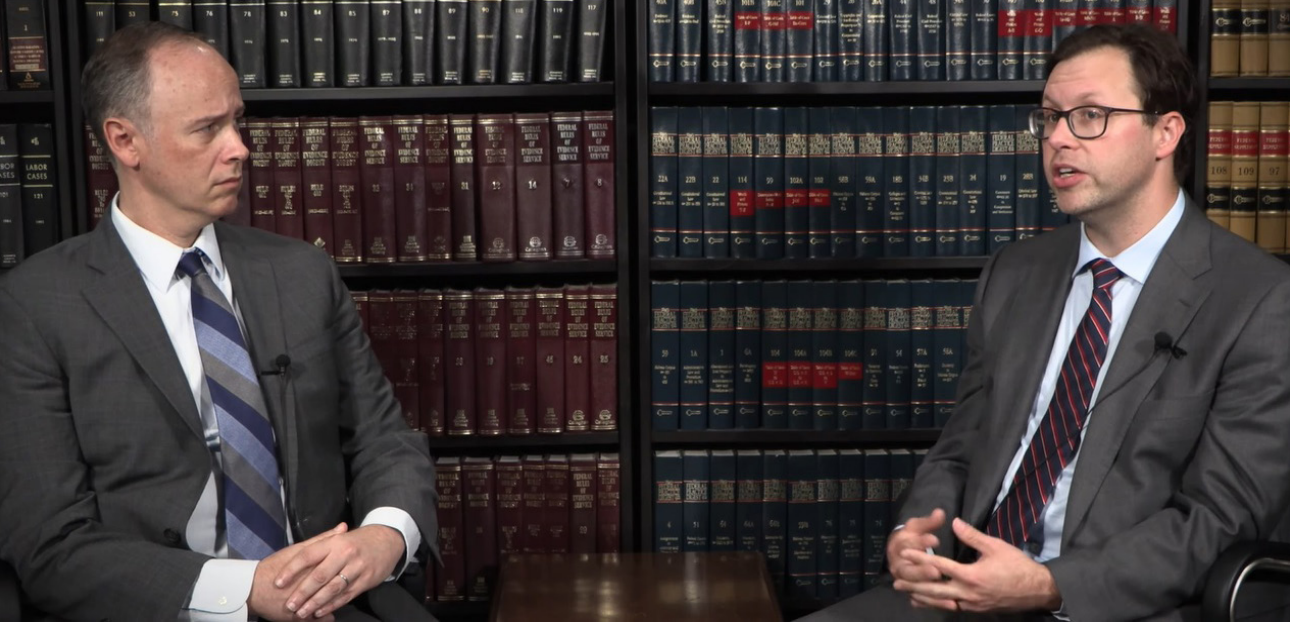
Starbucks employee Ariana Cortes’ Foundation attorney, Aaron Solem (right), is making a cutting-edge argument targeting the NLRB’s lack of accountability.
WASHINGTON, DC – The National Labor Relations Board (NLRB) is supposed to protect the right of workers to freely choose whether to associate with a union or not. The NLRB is also charged with holding unions and employers accountable when they violate worker rights. Too often, however, it has simply acted as an agency that generates policies to entrench union bosses’ power over workers while shielding union bosses from any kind of liability.
A new federal lawsuit from a National Right to Work Foundation-backed Starbucks employee, currently pending at the D.C. District Court, could upend the federal agency and result in a ruling that the current Labor Board’s structure violates the Constitution.
Employee Challenges NLRB Bureaucrats’ Protections from Presidential Removal
Ariana Cortes, a worker at the Buffalo, NY, “Del-Chip” Starbucks branch, hit the NLRB with the groundbreaking lawsuit in October, contending that the federal agency’s current structure violates the separation of powers mandated by the Constitution.
Cortes’ suit follows Foundation attorneys’ defense of her and her coworkers’ petition requesting a vote to remove Starbucks Workers United (SBWU) union officials from their workplace. Regional NLRB officials dismissed Cortes’ majority-backed petition based on SBWU allegations against Starbucks management that have no proven connection to Cortes and her coworkers’ desire for a union decertification vote.
Cortes’ lawsuit argues that because NLRB members cannot be removed at-will by the President, the NLRB’s structure violates Article II of the Constitution. Under Article II, the lawsuit contends, the President must have the power to remove officials that exercise substantial executive power.
Because the NLRB enforces federal labor law, manages union elections, and can issue legally binding rules and regulations, the lawsuit contends that the agency exercises substantial executive power. Therefore, it falls within the scope of the President’s power to remove officials at will. However, the National Labor Relations Act (NLRA), the law that established the NLRB, restricts the President’s ability to remove Board members except for neglect of duty or malfeasance.
“[T]hese restrictions are impermissible limitations on the President’s ability to remove Board members and violate the Constitution’s separation of powers. Thus, the Board, as currently constituted, is unconstitutional,” the complaint states.
Lawsuit: Unconstitutional NLRB Proceedings Must Stop
Cortes’ new federal lawsuit seeks a declaration from the District Court that the structure of the NLRB as it currently exists is unconstitutional.
“For too long the NLRB, especially the current Board, has operated as a union boss-friendly kangaroo court, complete with powerful bureaucrats who exercise unaccountable power in violation of the Constitution,” commented National Right to Work Foundation Vice President and Legal Director William Messenger. “The NLRB’s operation outside constitutional norms is easily exploited by Big Labor.”
“But as the story of Ms. Cortes shows, the NLRB’s unchecked power creates real harms for workers’ rights, especially when workers seek to free themselves from the control of union bosses they disagree with,” Messenger added.
Buffalo Starbucks Baristas Blast National Labor Relations Board’s Move to Trap Workers in Union at Court of Appeals
NLRB lawyers claim workers’ opposition to union “justifies” union being imposed on unwilling employees
Buffalo, NY (November 28, 2023) – Ariana Cortes and Logan Karam, Starbucks partners in the Buffalo area, have just filed an amicus brief in the Second Circuit Court of Appeals case Leslie v. Starbucks Corp. In the case, NLRB officials are attempting to prosecute Starbucks for misconduct alleged by SEIU-affiliated Workers United union officials. The NLRB cites a petition that Cortes and her coworkers filed seeking a vote to remove the union as a reason why Starbucks management should be subjected to a court-ordered injunction.
Cortes and Karam, who are represented for free by National Right to Work Legal Defense Foundation staff attorneys, challenge this legal maneuver in their brief. The employee’s brief argues that the NLRB’s strategy treats workers as if they have no agency of their own and have no independent reasons for wanting to get rid of a union.
“Given the biases of the current Board, it is disheartening ― but not surprising ― to see the NLRB claim Cortes’ petition is the product of Starbucks’ alleged unfair labor practices,” the brief states. “Its own records show that nothing could be further from the truth. In reality, Cortes collected her petition because of the Union’s anti-employee behavior.”
The employees’ brief also contends that the relief NLRB lawyers are seeking from the Second Circuit – a 10(j) injunction under the National Labor Relations Act (NLRA) that will force Starbucks managers into working with SBWU union bosses to craft a monopoly bargaining contract – is extreme. Such injunctions can only be ordered when the harm done to workers in their absence would be “irreparable.” Foundation attorneys argue that the fact that Cortes and other employees have attempted to decertify does not make any injuries suffered by the union “irreparable.”
“The NLRB’s argument it needs an injunction to suppress decertification efforts already underway―which have already garnered majority support―is a tacit admission it is seeking to alter the status quo, not preserve it,” states the brief.
Cortes is also receiving Foundation legal aid in a case challenging the constitutionality of the NLRB’s structure. That case, currently pending at the D.C. District Court, argues that the structure of the NLRB is unconstitutional.
Dangerous Precedent Set If Court Grants Anti-Worker Injunction
If the Second Circuit grants the NLRB’s request for an injunction on behalf of SBWU union bosses, it would be the first time that a federal court has ordered a Starbucks store to engage in bargaining with union bosses on the basis of an employee’s decertification petition. This would be a horrendous precedent for independent-minded Starbucks workers across the country.
Starbucks workers all across the country have submitted decertification petitions seeking votes to remove SBWU union bosses, including at least nine groups of employees who are utilizing free Foundation legal aid. The NLRB would be able to use the federal court precedent to make the dubious argument that union bargaining should be mandated simply because employees want a chance to oust the union.
“The NLRB is digging an even deeper grave for employees trying to exercise their rights to remove an unwanted union from their workplace,” commented National Right to Work Foundation President Mark Mix. “The Board’s attempt to twist employees’ desire to exercise their right to throw out a union into a reason to force a union upon them is a new low.”
“Ariana Cortes and Logan Karam are taking a courageous stand to ensure their coworkers aren’t disenfranchised and trapped under a union hierarchy they oppose, and we’re proud to support them,” Mix added.
Starbucks Workers Nationwide Rising Up Against Union Representation
The following article is from the National Right to Work Legal Defense Foundation’s bi-monthly Foundation Action Newsletter, September/October 2023 edition. To view other editions of Foundation Action or to sign up for a free subscription, click here.
Foundation provides free legal aid to Starbucks employees looking to remove unions
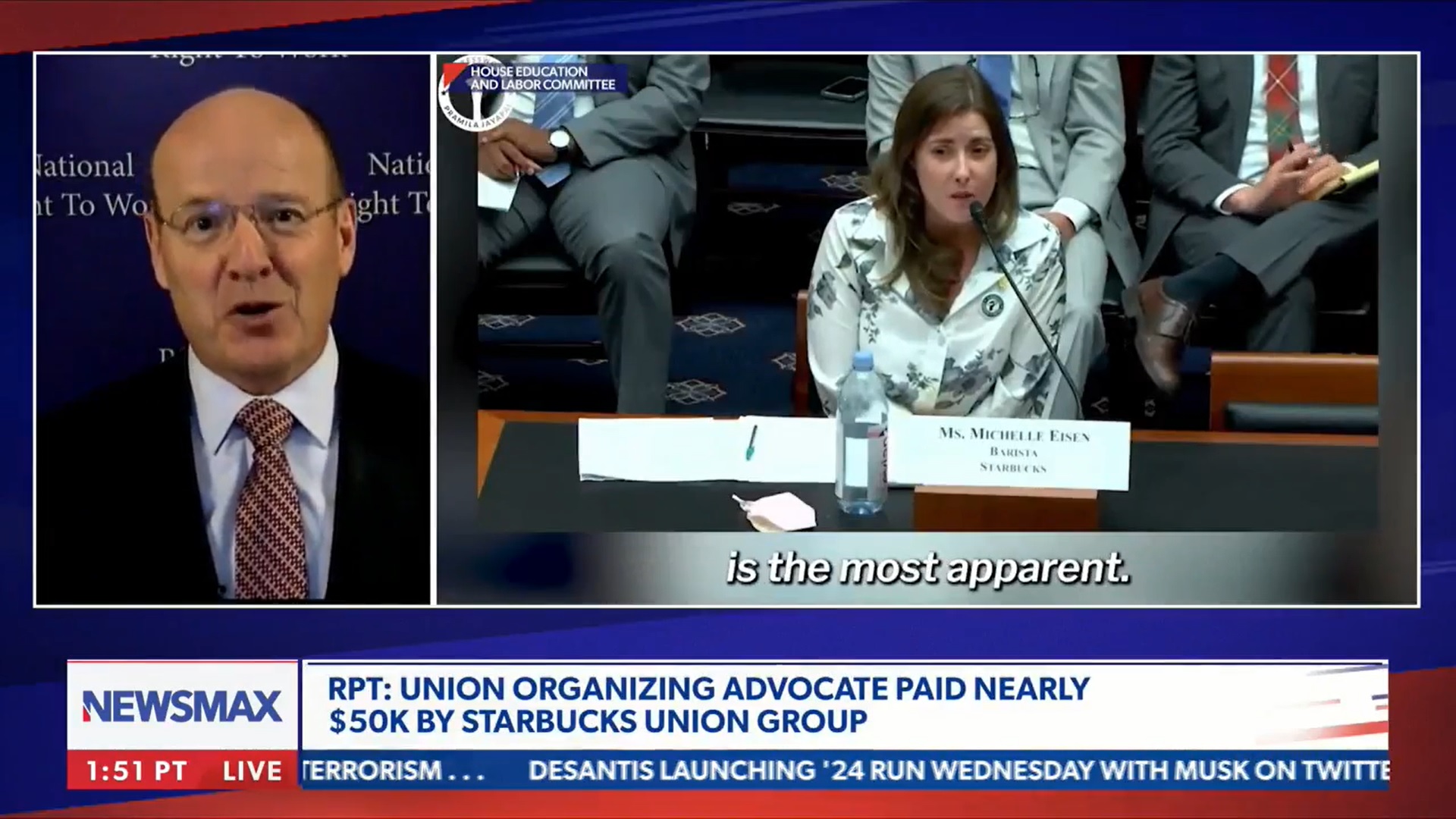
Mark Mix appeared on Newsmax TV this summer to discuss reports that union bosses spent millions to infiltrate Starbucks workforces with union agitators, many of whom hid their affiliations from their coworkers and even Congress.
WASHINGTON, DC – Union bosses and their bought-and-paid-for political allies like Sen. Bernie Sanders and Rep. Alexandria Ocasio-Cortez have been touting the unionization of some Starbucks locations as a breakthrough for Big Labor. But Starbucks employees under union control are increasingly realizing the drawbacks of having union bosses in the workplace and are banding together to say “NO” to union power.
In the last few months, employees at Starbucks locations in Manhattan and Buffalo, NY, Pittsburgh, PA, Minneapolis, MN, and Salt Lake City, UT, have all filed decertification petitions at the National Labor Relations Board (NLRB), requesting the agency hold elections at their stores to remove the Starbucks Workers United (SBWU) union. All have received free legal aid from National Right to Work Foundation attorneys.
But SBWU union officials — boosted by operatives from their notorious puppeteer, the Service Employees International Union (SEIU) — are fighting tooth and nail to remain in power at Starbucks locations where workers want them gone.
SBWU union officials are flooding the National Labor Relations Board (NLRB) with unrelated charges of alleged employer wrongdoing in an attempt to stall these decertification petitions.
Starbucks Worker’s Brief Blasts NLRB Double Standard on Elections
In June, Foundation staff attorneys filed a Request for Review with the NLRB in Washington, D.C., as a part of a case for Buffalo Starbucks worker Ariana Cortes. This request asks the Board to reverse an NLRB Regional Director’s order dismissing Cortes and her coworkers’ majority-backed petition for a decertification election on whether to remove SBWU.
The filing emphasizes that the employees want an election to remove a union that lacks the support of a majority of the workers. Employee free choice is a fundamental principle of the National Labor Relations Act (NLRA), and by denying these employees an election, the Board is undermining free choice.
The brief also observes the basis for blocking the vote is contradicted by the NLRB allowing union-backed certification elections to proceed with little or no delay. The result is that the SEIU is like a roach motel, easy to enter but impossible to leave.
Efforts to Boot SBWU Increasing Across Country
“They have treated us like pawns, promising us that we could remove them after a year if we no longer wanted their representation, and are now trying to stop us from exercising our right to vote,” Cortes said of SBWU union bosses. “It’s obvious they care more about power and control than respecting our individual rights.”
Cortes and her coworkers are not the only workers to become disillusioned with SBWU.
Foundation attorneys recently began representing employees at Starbucks branches at Pittsburgh’s Penn Center East, the Mall of America in Bloomington, MN, and Cottonwood Heights in the Salt Lake Valley, UT, who also submitted petitions demanding decertification votes on SBWU union officials.
“SBWU union bosses have not looked out for the interests of me and my fellow employees,” commented Pittsburgh Starbucks employee Elizabeth Gulliford. “We simply want to exercise our right to vote out a union that we don’t believe has done a good job, and both SBWU and Starbucks should respect that right and our final decision.”
The Starbucks employee-led decertification attempts all took place about one year after union power was installed at these stores — meaning workers seized the opportunity to decertify nearly as soon as legally possible. Federal labor law prevents workers from exercising their right to remove an unpopular union for at least one year after the union is installed.
Biden NLRB Propping Up Union Boss Attempts to Squash Votes
“It is becoming increasingly obvious that SBWU officials seek to extend their power over as many Starbucks workers as possible, with little regard for the employees they claim to ‘represent,’” commented National Right to Work Foundation Vice President and Legal Director William Messenger. “And as we’ve seen in Ms. Cortes’ case in Buffalo, Biden NLRB officials are more than willing to indulge union bosses’ legal maneuvers to cling onto power even when workers have clearly had enough.”
“SBWU officials should not seek to disenfranchise the Starbucks workers they claim to ‘represent’ as those workers try to flee the SBWU’s clutches,” Messenger added. “The union officials’ conduct shows why fundamental changes must be made to the NLRB’s election processes to better protect employee free choice.”
Buffalo Starbucks Worker Files Groundbreaking Lawsuit Challenging Constitutionality of NLRB Structure
Regional NLRB blocked employee and her coworkers from voting out union majority disapproved of, new lawsuit challenges agency’s authority
Buffalo, NY (October 4, 2023) – Buffalo “Del-Chip” Starbucks employee Ariana Cortes has hit the National Labor Relations Board (NLRB) with a federal lawsuit, arguing that the federal agency’s current structure violates the separation of powers. The lawsuit, filed with the District Court for the District of Columbia, follows Cortes’ challenge to an NLRB Regional Director’s dismissal of her and her coworkers’ petition seeking a vote to remove Starbucks Workers United (SBWU) union officials from their store.
Cortes is receiving free legal aid in both proceedings from the National Right to Work Legal Defense Foundation. The lawsuit contends that, because NLRB Board Members cannot be removed at-will by the President, the NLRB’s structure violates Article II of the Constitution.
The National Labor Relations Act (NLRA), the law which established the Board, restricts a president’s ability to remove Board members except for neglect of duty or malfeasance. The complaint argues that “[t]hese restrictions are impermissible limitations on the President’s ability to remove Board members and violates the Constitution’s separation of powers. Thus, the Board, as currently constituted, is unconstitutional.”
“The Supreme Court made clear in Seila Law LLC v. CFPB, 140 S. Ct. 2183 (2020) and Collins v. Yellen, 141 S. Ct. 1761 (2021) that under Article II of the Constitution, the President must be able to remove federal officials who exercise substantial executive power,” the complaint states. “The five-member NLRB exercises substantial executive power because it issues binding rules, adjudicates unfair labor practices and representation disputes, issues subpoenas, and decides whether and how to direct and conduct elections in representation cases.”
Regional NLRB Dismisses Starbucks Employees’ Request to Vote Out Union
On April 28, Cortes filed a petition, backed by the majority of her coworkers, that requests the NLRB conduct a decertification election at her workplace to end the monopoly bargaining power of SBWU union officials. NLRB Region 3 dismissed Cortes’ petition based on unfair labor practice charges SBWU union officials filed against Starbucks, despite there being no proven connection between those allegations and the decertification petition.
Cortes’ Foundation-provided attorneys filed a Request for Review with the Board challenging this dismissal order. That appeal contrasted the standard the NLRB often applies to petitions to certify unions, which usually proceed with little to no delay, with the standard the NLRB applies to petitions to decertify unions, which are often hamstrung and delayed.
New Federal Lawsuit Seeks to Temporarily Enjoin Unconstitutional Proceedings
Cortes’ new federal lawsuit seeks a declaration from the District Court that the structure of the NLRB as it currently exists is unconstitutional, and an injunction halting the NLRB from proceeding with her decertification case until her federal lawsuit is resolved.
“For too long the NLRB, especially the current Board, has operated as a union boss-friendly kangaroo court, complete with powerful bureaucrats who exercise unaccountable power in violation of the Constitution,” commented National Right to Work Foundation President Mark Mix. “As the story of Ms. Cortes shows, the NLRB’s unchecked power creates real harms for workers’ rights, especially when workers seek to free themselves from the control of union bosses they disagree with.”
Starbucks Worker Asks Labor Board to Review Order Denying Vote to Remove Unwanted Union
Request for Review to full National Labor Relations Board says Regional Director erred in dismissing workers’ petition
Buffalo, NY (June 12, 2023) – National Right to Work Legal Defense Foundation staff attorneys have filed a Request for Review with the National Labor Relations Board (NLRB) in Washington, D.C. This requests asks the Board to reverse a Regional Director’s order dismissing a workers’ petition for a decertification election on whether to remove the so-called Starbucks Workers United (SBWU) union, an affiliate of Service Employee International Union (SEIU). The request is part of a case that began when Ariana Cortes, a Buffalo Starbucks worker, filed a petition with the NLRB requesting the decertification election be held at the “Del Chip” Starbucks location where she works.
Cortes’ decertification petition, which was filed on April 28, has support from a majority of her coworkers who also want to remove the union from their workplace. After her initial filing, Cortes began receiving free legal assistance from National Right to Work Legal Defense Foundation staff attorneys.
“They have treated us like pawns, promising us that we could remove them after a year if we no longer wanted their representation, and are now trying to stop us from exercising our right to vote,” Cortes said in a statement about why so many of her coworkers support removing the union. “It’s obvious they care more about power and control than respecting our individual rights.”
Under federal law, workers can trigger an NLRB-supervised decertification election with the signatures of 30% or more of the employees in a workplace. After receiving the petition, NLRB officials should then promptly move to schedule an election. However, on May 25, the NLRB Region 3 Regional Director issued an order dismissing the decertification petition.
In response to this order, Cortes’s Foundation staff attorneys filed the request for review with the four member NLRB in Washington, DC. The filing emphasizes the wishes of the employees to continue with the decertification process to remove the monopoly union representation that lacks the support of a majority of the workers, which is a fundamental principle of the National Labor Relations Act that the NLRB is charged with enforcing.
The brief also observes that the grounds for blocking the vote is contradicted by the NLRB allowing union-backed certification elections to proceed. The result is that the SEIU is like a roach motel, easy to enter but impossible to leave.
“The Region dismissed her petition and disenfranchised her and her fellow employees of the right to choose their representative—the same right that has been granted over 350 times to employees seeking certification,” the brief states.
So far, workers at three different Starbucks locations in New York State have filed decertification petitions. In addition to the Del Chip store, Foundation staff attorneys also represent the petitioner in the Starbucks Roastery case, where a majority of workers also support the decertification effort.
The Foundation has also issued a legal notice to all Starbucks employees, offering free legal aid to any worker who may be interested in removing SBWU’s so-called “representation” from their workplace: www.nrtw.org/starbucks
“Workers have a statutory right to decertify a union they oppose, and it is outrageous that the Regional Director has so callously moved to disenfranchise these workers of that right,” commented National Right to Work Legal Defense Foundation President Mark Mix. “The NLRB must reverse course and cease acting like its mission is simply to protect incumbent union officials against workers who are opposed to unions’ so-called representation.”





