
Appeals Court Affirms Ruling That Union Bosses Violated Michigan’s Right to Work Law
The following article is from the National Right to Work Legal Defense Foundation’s bi-monthly Foundation Action Newsletter, March/April 2019 edition. To view other editions or to sign up for a free subscription, click here.

When teacher union bosses flouted Michigan’s Right to Work Law, Ron Conwell turned to Foundation staff attorneys to enforce his rights.
Teacher’s case resulted in first fine against union officials for illegal forced dues requirement
DETROIT, MI – When union bosses informed teacher Ron Conwell that he must pay union fees or lose his job, he sought free legal aid from Foundation attorneys to challenge the requirement as illegal under Michigan’s popular Right to Work protections.
Michigan’s Right to Work Law went into effect on March 28, 2013. Contracts or agreements entered into after the law went into effect must respect workers’ right to refrain from the payment of any union dues or fees as a condition of employment.
Worker Halts Union’s Illegal Attempt to Extend Forced Fees for Teachers
The Clarkston Education Association (CEA) and Michigan Education Association (MEA) illegally extended the forced-dues clause in their monopoly bargaining agreement with Clarkston Community Schools after the Right to Work Law took effect.
In August 2015, Conwell resigned his union membership. Later that month, union officials informed him that he was still required to pay union fees or be fired.
“It seemed like to me that the union was trying to find some way to take the law that was put into place so that I had a right to decide, and then take that decision away from me,” Conwell said.
Foundation attorneys brought charges for Conwell to challenge the union bosses’ coercion.
In 2017, the Michigan Employment Relations Commission (MERC) ruled that CEA and MEA violated the state’s Right to Work protections for public employees by illegally extending and enforcing a forced-dues clause. The Commission ordered the unions to stop threatening employees with termination based on the clause.
MERC also held that Clarkston Community Schools officials violated the law by agreeing to union officials’ demands for the illegal extension. MERC fined both the school district and the unions, making the case the first of its kind in which violators of the Right to Work law were fined.
Union lawyers appealed the ruling but were met with defeat, as the Appeals Court affirmed MERC’s ruling and fine, upholding workers’ Right to Work protections.
The victory demonstrates that the Foundation’s legal aid program remains vital to protect independent-minded workers from Big Labor’s coercive tactics.
Foundation staff attorneys have litigated more than 100 cases in Michigan since Right to Work legislation was signed into state law in December 2012.
“Michigan workers can celebrate that the decision upholds their right to work without paying forced tribute to union bosses,” said Ray LaJeunesse, vice president of the National Right to Work Foundation. “Yet it also shows that workers need to keep fighting against coercion, as Michigan union bosses have repeatedly violated the state’s Right to Work laws in their efforts to keep their forced dues money stream flowing. Foundation staff attorneys continue to assist dozens of independent-minded workers in resisting Big Labor’s orchestrated campaign to undermine Right to Work in Michigan.”
Foundation Victory: Workers Cannot Be Forced to Fund Union Lobbying
The following article is from the National Right to Work Legal Defense Foundation’s bi-monthly Foundation Action Newsletter, May/June 2019 edition. To view other editions or to sign up for a free subscription, click here.
NLRB also rules that union bosses must provide independent verification of forced fees audit

Nurse Jeanette Geary challenged Big Labor’s coercive tactics after discovering that union bosses were forcing her to pay for union lobbying activities.
WASHINGTON, D.C. – Nine years after filing her case over forced union fees, former Rhode Island nurse Jeanette Geary finally claimed victory over union bosses’ illegal scheme.
The National Labor Relations Board (NLRB) issued a sweeping decision in Geary’s case, providing new protections for workers and accountability over forced fees calculations.
Geary, then a nurse at Kent Hospital in Warwick, Rhode Island, filed an unfair labor practice charge against the United Nurses and Allied Professionals (UNAP) union in 2009 with free legal aid from Foundation staff attorneys.
She filed the charges after UNAP officials failed to provide an independent auditor’s verification that its breakdown of expenditures had been audited. She also challenged the union’s forcing her and other employees to pay for union lobbying activities in violation of the Foundation-won U.S. Supreme Court Beck decision.
“For someone to tell me that they’re going to take my money that I have earned working very hard, and they’re going to use it for their political purposes, you know — that makes me very, very angry,” Geary said.
When Geary discovered what was happening with the union fees she was forced to pay, it was about more than money. “I don’t like to be manipulated because I am a nurse. Just because I nurse and you turn your light on and I’ll be there and I’ll do anything that you need to promote your well-being, that doesn’t mean you can step on me. It was a deep-down, personal, gut reaction to [the union officials] who decided not only would they label me as ignorant and stupid and laugh about me in their office, but they would also take my money.”
The Obama NLRB had issued a bad decision in Geary’s case in 2012, but the ruling was invalidated by the Supreme Court’s 2014 holding in NLRB v. Noel Canning. The Supreme Court agreed with the Foundation’s amicus brief that the Board lacked a valid quorum because of three unconstitutional “recess appointments” then President Obama made.
Five years later, Geary’s case was the only remaining case invalidated by Noel Canning that was still pending without a decision by the NLRB.
In January 2019, Foundation staff attorneys filed a petition at the U.S. Court of Appeals for the District of Columbia Circuit, seeking a court order that the NLRB promptly decide Geary’s case. The Appeals Court then ordered the NLRB to respond to the mandamus petition by March 4, which caused the NLRB to issue its decision on March 1, just ahead of the deadline.
The NLRB’s 3-1 decision held that union officials violate workers’ rights by forcing non-members to fund union lobbying activities. It also ruled that union officials must provide independent verification that the union expenses they charge to non-members have been audited.
“Jeanette Geary bravely fought against Big Labor’s workplace coercion for years, resisting a blatant refusal to respect her rights and those of the workers union officials claim to represent,” said National Right to Work Foundation Vice President Patrick Semmens. “Although this is an overdue victory for Jeanette Geary, ultimately these types of forced union abuses will never be eliminated until Big Labor’s power to force workers to pay union dues or fees as a condition of employment is completely eliminated.”
National Right to Work Foundation Publishes Special Legal Notice for Workers at St. Vincent Hospital
In response to inquiries from impacted employees, the National Right to Work Legal Defense Foundation has published a special legal notice for nurses and support staff ordered by United Auto Workers (UAW) union officials to go on strike at St. Vincent Hospital in Toledo, Ohio.
Workers interested in returning to work should read the notice before doing so to learn their their rights and protect themselves against attempts by union officials to levy punitive fines against workers who return to work.
St. Vincent’s nurses and support personnel should know they have the following rights:
1) You have the right to resign your membership in the union. If you don’t support this union, you can send the union a letter resigning your membership. A sample letter can be found HERE.
2) You have the right to go to work even if the union bosses order a strike. Union officials can (and often do) levy onerous monetary fines against union members who work during a strike. So, you should seriously consider resigning your union membership BEFORE you return to work during a strike, which is the only way to avoid these ruinous union fines and discipline. See Union Discipline and Employee Rights.
Your resignation letter must be postmarked THE DAY BEFORE you return to work, or hand delivered BEFORE you actually return to work. A sample letter is HERE.
3) You have the right to revoke your dues checkoff and stop paying dues during the period when there is no collective bargaining agreement in effect. You must send a letter to St. Vincents and the UAW to accomplish this. A sample letter is HERE.
4) You have the right to sign and circulate decertification petitions to change your bargaining representative. Information on this option can be found here.
5) If the UAW union officials ever sign a new contract with St. Vincent, you have the right to become a “Beck objector” and pay only reduced financial core fees instead of full membership dues. If you become a Beck objector, you will not be forced to pay for the UAW unions’ far left political and social agenda. Information about this option is found here.
According to the latest disclosure, the UAW admits that approximately 25% of its dues are spent on often controversial politics that you cannot legally be forced to pay.
Read the complete legal notice for St. Vincent Hospital nurses and support staff here.
The notice is note the only special legal notice recently issued in response workers needing to protect themselves from UAW officials’ actions.
The Foundation also recently published a special legal notice for autoworkers at Volkswagen’s Chattanooga plant informing them about their legal rights as UAW officials attempt to impose monopoly unionism on workers there. The special legal notice to Volkswagen employees, available in full here, summarizes these rights and notes that “workers not only have a right to learn information about the downsides of union affiliation, but also to share that information with their fellow team members”:
For example, UAW officials won’t want workers to learn about the many times UAW officials violated workers’ rights while enriching themselves, including in an ongoing federal corruption case that has already resulted in multiple top union officials going to jail. In fact, it the last ten years there have been 82 criminal enforcement actions against UAW officials by the U.S. Department of Labor and the Department of Justice for conspiracy to defraud, embezzlement, theft, knowledge of a conspiracy, and/or receiving prohibited payments.
Partially as a result of those violations, over the last 10 years the UAW’s reported total liabilities have increased to $115,925,262 as of 2018. Such financial desperation has led the UAW to violate federal labor law and Michigan’s Right to Work law, such as when it was caught red-handed forcing represented employees in Michigan, a Right to Work state like Tennessee, to pay dues against their will.
…
Get the facts before you sign your name on any UAW petition or decide to vote for the UAW officials in an election. Union officials cannot legally infringe on your rights to hear and disseminate information critical of the union and union officials.
You have the legal right to refrain from signing a union authorization card or voting for the UAW. You also have the legal right to rescind a union authorization card after it has been signed. Whether you wish to sign a union authorization card or vote for the UAW is completely up to you. It is unlawful for an employer or a union to threaten or coerce any employee in the exercise of these rights.
Workers can learn about their specific legal rights during a strike based on their industry by visiting the Foundation’s webpage: “What if I want to continue working during a strike?”
Call the National Right to Work Foundation at 800-336-3600 if you want to discuss your legal rights, or to request legal assistance. You can also use our free legal request form: https://www.nrtw.org/free-legal-aid
Labor Board Ruling: Michigan Teacher Union Officials Violated Employee’s Rights under Right to Work Law
In case brought by DeWitt school employee, MEA union ordered to stop illegal “window” policy blocking employees from ending dues payments
DeWitt, Michigan (May 10, 2019) – The Michigan Employment Relations Commission (MERC) has ruled in favor of a DeWitt public school employee and ordered the Michigan Education Association (MEA) teacher union and its local affiliate the DeWitt Educational Support Personnel Association (DESPA) to stop enforcing an illegal policy blocking workers from exercising their rights under Michigan’s Right to Work law.
The ruling is a victory for DeWitt Public Schools employee Kimberly Stepanski, who filed the case with free legal representation by National Right to Work Legal Defense Foundation staff attorneys after MEA and DESPA rejected her attempts to cut off union dues, using a union-created “window period” policy.
According to the ruling, the union-created “window period” scheme – which is designed to limit workers from stopping dues payments except for a brief, union-selected time period – violates Michigan’s Right to Work law. The ruling also requires MEA union officials to refund to Stepanski any dues money collected since her initial resignation and requires the union to notify other employees that the “window” policy is illegal.
Stepanski first learned of the union scheme after attempting to resign and cut off dues payments in November 2013, only to be told that she was forced to pay dues because she missed the union’s designated “window period.” Stepanski, who says she had never been informed of the union’s policy, later sent a series of emails to the union officials reaffirming her intent to exercise her right not be a union member and to not fund any union activities, as protected by Michigan’s Right to Work law for public employees.
The law, which doesn’t stop workers from voluntarily joining or paying dues to a union, forbids compelling “any public employee to…become or remain a member of a labor organization…or otherwise affiliate with or financially support a labor organization.” Despite that, MEA union officials rebuffed Stepanski’s requests, demanding that she continue paying dues because she had not submitted her resignation request during the “opt-out window.”
Stepanski, with free legal aid from the National Right to Work Foundation, then filed a charge at MERC in 2014 challenging the coercive scheme. In the ruling issued last week, MERC determined that MEA and DESPA had illegally “reject[ed] [Stepanski’s] revocation of her financial obligation and restrict[ed] her right to resign her membership at will.” It ordered the unions to end the “window period” scheme, stop collecting dues or fees from any employee after he or she has resigned union membership, and refund to Stepanski any dues that they had illegally taken since her November 2013 resignation.
The order is another recognition of the ruling in Saginaw, a 2015 Foundation-won case where MERC first found “window period” schemes to violate Michigan’s Right to Work law. That case and others brought by Foundation staff attorneys have resulted in numerous refunds for money taken under the illegal “window period” scheme.
“Even after National Right to Work Foundation staff attorneys have filed more than 100 cases against unions for forced unionism abuses since Michigan passed its Right to Work law, union bosses continue to systematically violate the rights of the very workers they claim to represent,” commented National Right to Work Foundation President Mark Mix. “Hopefully, rather than continue to fight to trap the rank-and-file into forced dues payments, Michigan union officials will finally accept that Right to Work is the law, and refocus their efforts on actually convincing Wolverine State workers to voluntarily choose union activities.”
Full Foundation Action March/April 2019 Newsletter Now Online
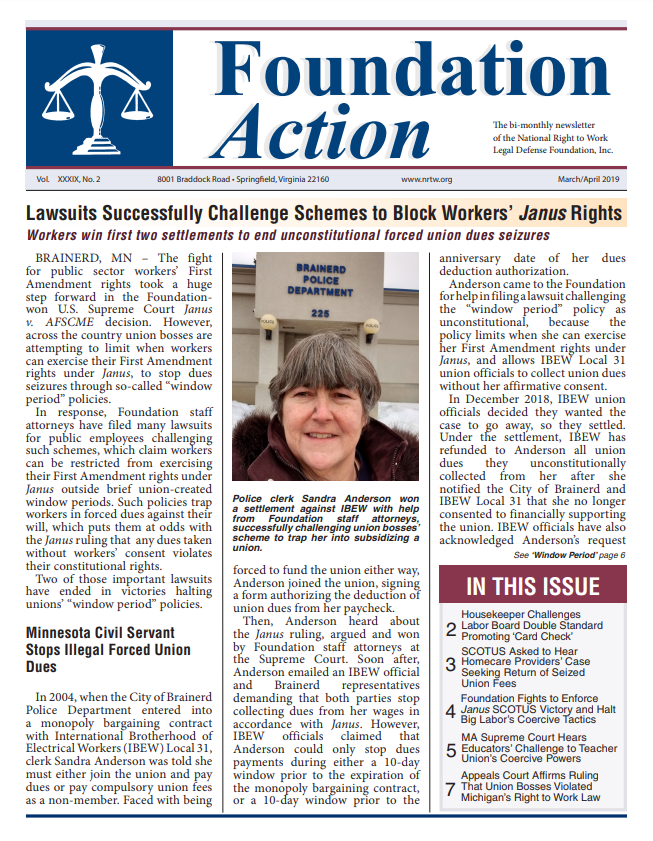
All articles from the March/April 2019 issue of Foundation Action are now on the website.
In this issue:
- Lawsuits Successfully Challenge Schemes to Block Workers’ Janus Rights
- Housekeeper Challenges Labor Board Double Standard Promoting ‘Card Check’
- SCOTUS Asked to Hear Homecare Providers’ Case Seeking Return of Seized Union Fees
- Foundation Fights to Enforce Janus SCOTUS Victory and Halt Big Labor’s Coercive Tactics
- MA Supreme Court Hears Educators’ Challenge to Teacher Union’s Coercive Power
- Appeals Court Affirms Ruling That Union Bosses Violated Michigan’s Right to Work Law
To view other editions or sign up for a free copy of the newsletter via mail, click here.
Rhode Island Bus Driver Asks NLRB to Overturn Policy Blocking Vote to Remove Teamsters Union
Union officials leveraging so-called “merger doctrine” to block workers from exercising right to hold decertification vote to remove minority union
Coventry, RI (April 10, 2019) – With free legal aid from National Right to Work Foundation staff attorneys, a Rhode Island bus driver has petitioned the National Labor Relations Board (NLRB) to allow a vote to decertify his local union. The filing argues the Labor Board’s “merger doctrine” being applied to block the vote is contrary to the National Labor Relations Act (NLRA).
Bradford Mayer, who works for school bus company First Student, Inc., circulated a decertification petition at his facility to remove Teamsters Local 251. He collected signatures from more than 30 percent of his colleagues at his workplace, as required to trigger an NLRB-supervised vote. However, Teamsters union officials moved to block the election on the grounds that Mayer and his colleagues were actually “merged” into a nationwide bargaining unit without their knowledge.
As his response to the NLRB notes, Mayer and his coworkers were unionized in a standalone local bargaining unit which has its own union contract. Thus they should be able to exercise their rights under the NLRA to remove the union. Instead, union officials take the position that they made a backroom deal with First Student, Inc. to “merge” the employees into a massive nationwide bargaining unit without their consent, despite the monopoly bargaining agreement not even referencing such a merger.
The “merger” effectively prevents any employee from organizing a decertification vote to reject representation by the union, which requires a worker to first obtain signatures from at least 30 percent of workers in the bargaining unit to hold a vote. Unlike paid union organizers, full time employees must collect signatures on their own time and are explicitly forbidden from receiving any meaningful assistance from management. Consequently, it is essentially impossible for workers to garner the necessary support at dozens of worksites spread around the country.
Mayer’s “Response to the Order to Show Cause” makes the point that workers have a clear legal right under the NLRA to hold a decertification vote in their workplace, and no agreement between company and union officials can waive that statutory right, which the secret merger agreement effectively does. The filing urges the NLRB to revisit the rules allowing union officials to impose such undemocratic “mergers” on workers as a means of creating decertification-proof bargaining units and promptly schedule a decertification vote for Mayer and his Rhode Island colleagues.
Various unions across the country have attempted to impose similar “mergers” before, relying on the NLRB-created “merger doctrine” as justification. Mayer’s petition calls on the NLRB to reject this so-called “merger doctrine,” because it has no basis in the NLRA and violates the act’s intended purpose of protecting employee free choice.
“Mr. Mayer and his colleagues should be allowed to decide freely whether they want to be represented by Teamsters Local 521,” says Mark Mix, President of the National Right to Work Foundation. “Union bosses have repeatedly used this so-called ‘merger doctrine’ to block workers, whom they claim to represent, from exercising their legal rights, so it is clearly time for the NLRB to reconsider this baseless rule.”
“For years the NLRB has created a web of bureaucratically created ‘rules’ not found in the National Labor Relations Act that block workers from removing unwanted unions from their workplace, and it is past time for this NLRB to move forward and stop the various games union bosses play to trap workers in unions opposed by a majority of employees,” Mix added.
Worker Advocate Urges Federal Labor Board to Simplify Process for Workers to Vote Out Union Representation
National Right to Work Foundation asks National Mediation Board to eliminate confusing ‘straw man’ decertification rules for airline and railroad workers
Washington, D.C. (April 1, 2019) – The National Right to Work Legal Defense Foundation has submitted comments to the National Mediation Board (NMB) supporting the agency’s proposed simplification of the rules enabling workers in the airline and railway industries to vote to remove a labor union that lacks the support of a majority of workers.
The NMB, which administers the Railway Labor Act (RLA), is currently considering rulemaking to modernize and update the rules for workers seeking to hold a vote to strip union officials of their monopoly bargaining powers. The process is particularly important since under federal law RLA unions can force workers to pay union dues or fees as a condition of employment, even where state Right to Work laws protect other employees from forced union dues.
Longstanding legal precedent unanimously upholds that the RLA allows workers to choose their representative or no representative at all. However, NMB rules, in particular the current “straw man” requirement, make exercising this right inordinately complex.
The confusing rule forces an individual employee to run as a “straw man” union to replace the incumbent union as the monopoly representative. Once elected by a majority of the workers, the new “straw man” representative may then disclaim collective representation, but is not legally required to do so.
The Foundation’s comments to the NMB explain that the current “confusing and obfuscatory process” undermines both the letter and spirit of the RLA:
“The proposed rules are long overdue. Employee free choice is the RLA’s most significant policy, and the proposed rules are needed to ensure that all employees have an equal and fair choice regarding union representation. The Board has statutory authority to adopt the proposed rules, and should do so as soon as possible.”
National Right to Work Foundation President Mark Mix also commented on the long overdue reform:
“This proposed change is a commonsense reform to the current process which only makes sense if the goal is to confuse workers about their rights to remove an unwanted union. Ultimately the Railway Labor Act has many fundamental problems that require legislative action, not the least of which is that it grants union bosses the power to have workers fired for nonpayment of union dues or fees even in states with Right to Work laws. However, while we wait action from Congress to fix those greater injustices, adopting this basic change within the confines of the flawed RLA is well worth doing.”
In addition to submitting the formal comments, veteran Foundation staff attorney Glenn M. Taubman testified at the NMB hearing on March 28 in favor of the proposed rule change.
Teachers Win Case at Michigan Court of Appeals Against Union Officials for Violating Right to Work Law
Court affirms ruling against union officials who demanded that two Ann Arbor teachers continue to pay union fees after resigning union membership
Ann Arbor, Michigan (March 22, 2019) – Two public school teachers have won a victory at the Michigan Court of Appeals with free legal assistance from National Right to Work Foundation staff attorneys after union officials violated their legal rights.
The court affirmed the Michigan Employment Relations Commission (MERC) finding that union officials with the Ann Arbor Education Association (AAEA) union, an affiliate of the Michigan Education Association (MEA) union, violated the rights of teachers Jeffrey Finnan and Cory Merante under Michigan’s Right to Work Law by demanding that they continue to pay union fees even though they had resigned their union membership. The teachers both worked for the Ann Arbor School District.
Michigan’s Right to Work statutes, which went into effect in March 2013, protect workers from being forced to pay union dues as a condition of employment and allow workers to cut off all union dues or fees after resigning their union membership.
Finnan and Merante each filed unfair labor practice charges against the AAEA because union officials demanded that they continue paying union fees after resigning union membership. An administrative law judge (ALJ) sided with the teachers, finding that union officials had engaged in unfair labor practices by demanding that the teachers continue to pay union fees.
MERC affirmed the ALJ’s findings and ordered the union to cease and desist from demanding payment of union fees from the nonmembers in violation of their rights.
Union officials appealed, but the Michigan Court of Appeals now has affirmed MERC’s decision. The court agreed that union officials had violated the rights of Finnan and Merante under Michigan’s Right to Work Law to refrain from financially supporting the union.
“This ruling by the Michigan Court of Appeals upholds Right to Work protections for workers laid out clearly in state law,” said Mark Mix, president of the National Right to Work Foundation. “Time and again, Michigan union bosses have demonstrated that they will stop at nothing to obtain membership dues and union fees from the workers they supposedly represent, regardless of workers’ wishes.”
Since Right to Work legislation was signed into state law in December 2012, Foundation staff attorneys have litigated more than 100 cases in Michigan to combat compulsory unionism.
Worker Victory: NLRB Overturns Region’s Order Forcing Hospital Employees into Union they Never Supported and Overwhelmingly Opposed
Washington, DC (March 1, 2019) – The National Labor Relations Board (NLRB) has issued a decision overturning a Regional Director’s decision forcing employees at Lehigh Valley Hospital-Schuylkill East in Pennsylvania under the so-called “representation” of Service Employees International Union (SEIU) bosses even though the workers opposed the union and rejected an SEIU organizing drive targeting them.
National Right to Work Foundation staff attorneys represented a group of employees in the case, providing free legal assistance to hospital employees challenging the Regional Director’s ruling.
National Right to Work Foundation President Mark Mix released the following statement regarding the decision:
“This ruling is a much needed victory for workers over a shameful union power grab aided and abetted by a demonstrably partisan Regional Director who only a few years ago was suspended for his pro-union conduct that violated NLRB ethics rules. Despite the workers in this case successfully resisting an SEIU organizing drive, union bosses attempted to game the NLRB system to force these workers into union forced-dues ranks. The unanimous Board decision overturning the Regional Director’s order is evidence of just how radical the accretion in this case was, and how the accretion doctrine undermines the premise of the National Labor Relations Act which is supposedly based on the idea that workers have a say in whether or not they are unionized.”
Learn more about the case here.
Labor Board Judge Rules UAW Violated Ford Worker’s Rights by Seizing Union Dues
NLRB finding: Seizure of dues by union officials from Ford employee was a violation of his rights and “more than mere negligence”
Washington, D.C. (February 26, 2019) – Ford Motor Company employee Lloyd Stoner won a ruling against the United Automobile Workers (UAW) Local 600 in Dearborn, Michigan, in his federal labor case with free legal assistance from National Right to Work Foundation staff attorneys.
Administrative Law Judge Michael A. Rosas ruled that UAW Local 600 engaged in unfair labor practices, prohibited by the National Labor Relations Act, by accepting union dues deducted from Stoner’s wages for two-and-a-half months after he resigned union membership and revoked his authorization to deduct dues. The union also failed to refund any of the dues taken without Stoner’s consent for nearly five months after his revocation and then belatedly failed to refund the entire amount owed him.
Stoner had already won a favorable settlement last month from Ford, which was charged in a separate complaint for deducting the unauthorized dues from his paycheck.
ALJ Rosas found that union officials restrained Stoner from exercising his legal rights. Workers are entitled to resign union membership at any time under federal law. Furthermore, Michigan’s Right to Work Law passed in 2012 states that nonmembers cannot be required to pay any union dues or fees as a condition of their employment. So, failing to promptly allow Stoner to resign his union membership and stop paying union dues constituted an unfair labor practice.
Moreover, ALJ Rosas found that upon receiving Stoner’s resignation and dues deduction authorization revocation, UAW Local 600 Financial Secretary Mark DePaoli “decided to sit on it for a while” instead of providing a timely notice to Ford about Stoner’s resignation and dues deduction authorization revocation. This resulted in Ford deducting dues from Stoner’s paycheck without authorization for an additional 10 weeks, which constituted an additional unfair labor practice under federal labor law.
DePaoli “provided a vague and less than credible explanation” for his failure to properly notify Ford to stop remitting dues to the union, Rosas explained, adding that DePaoli’s inaction represented “more than mere negligence.”
ALJ Rosas ruled that the dues deduction card that Stoner signed did not require workers to pay any dues or fees after resigning membership in the union. Union officials therefore had no legal authorization to accept any further dues deducted from Stoner’s wages after his resignation.
Under the ruling, UAW Local 600 must refund all dues taken from Stoner after his resignation, with interest. In addition, union officials must post notices at Ford’s Dearborn factory acknowledging that the union violated federal labor law and will honor all requests to resign union membership and cut off dues deductions.
“This decision in favor of Mr. Stoner is a victory for all Michiganders who wish to exercise their rights under the state’s Right to Work Law,” said Mark Mix, president of the National Right to Work Foundation. “Union bosses are officially on notice that they cannot continue seizing dues from employees after they resign their union membership.”
“Big Labor has consistently refused to acknowledge the rights of workers it claims to represent, requiring Foundation staff attorneys to litigate more than 100 cases for Michigan workers since the state’s Right to Work Law was passed in 2012,” added Mix. “As long as Michigan union bosses continue their forced unionism abuses, the National Right to Work Foundation will assist workers seeking to free themselves from these coercive tactics.”





