
The following article is from the National Right to Work Legal Defense Foundation’s bi-monthly Foundation Action Newsletter, March/April 2026 edition. To view other editions of Foundation Action or to sign up for a free subscription, click here.
New majority at federal labor board can eliminate ‘blocking charge’ policy
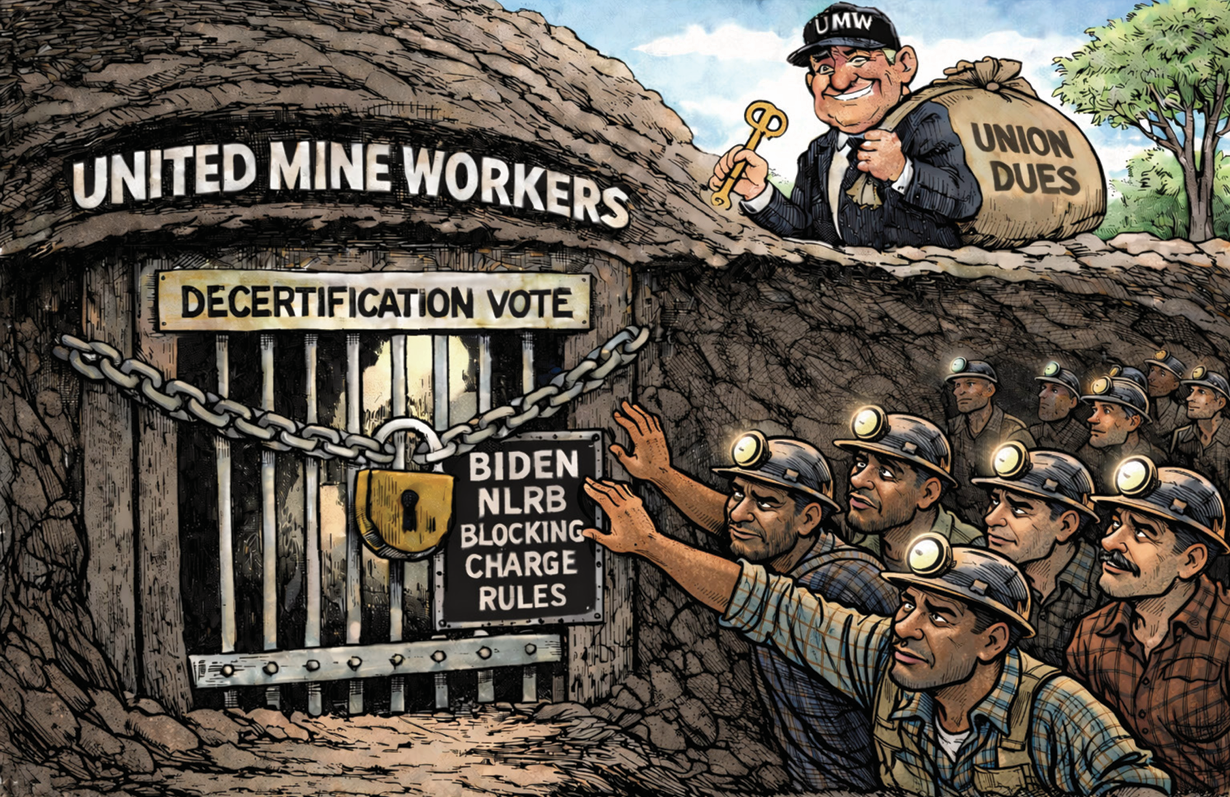
The Biden NLRB’s “blocking charge” policy serves only to trap workers under union “representation” that they’ve rightfully sought a vote to oust. But courageous miners in North Carolina are now taking a stand against this unfair policy.
SPRUCE PINE, NC – Known by the moniker “The Mineral City,” Spruce Pine is famous for being the origin of a large amount of the world’s high-purity quartz, a key component in manufacturing semiconductors. But now, it’s also the source of a legal challenge that could reshape the American labor law landscape in favor of worker freedom.
Blake Davis, a miner for The Quartz Corp., is challenging a Biden era National Labor Relations Board (NLRB) policy that is blocking him and his coworkers from voting in a worker-requested election to remove United Mine Workers (UMW) union officials from their workplace. This policy, called the “blocking charge” policy, hands union officials the power to stymie the union removal (or “decertification”) process simply by filing unproven, unsubstantiated, or unrelated “unfair labor practice” charges at the NLRB alleging employer misconduct.
Filing: ‘Blocking Charge’ Policy Clashes With Federal Law and Workers’ Rights
Davis collected and submitted a petition for a decertification vote in late 2025, which contained enough of his colleagues’ signatures to trigger a vote under NLRB rules. However, regional NLRB officials have blocked the vote due to the NLRB’s current blocking charge policy.
Davis, with the help of Right to Work attorneys, has now submitted a Request for Review to the NLRB in Washington, DC, which asks the Board to overturn the blocking charge policy and let him and his coworkers vote on whether to remove the UMW union. Since his brief was submitted, the U.S. Senate approved two new presidential appointees to the NLRB, meaning the Board now has a “quorum” and can decide this case and others.
Davis’ Request for Review argues that the NLRB’s blocking charge policy directly conflicts with the text of the National Labor Relations Act (NLRA), the federal law that the NLRB is responsible for enforcing. Davis’ brief contends that the rule lets self-interested union officials unilaterally block an election, even though the NLRA explicitly orders the Board to conduct an election whenever employees submit a valid decertification petition.
Davis’ brief also maintains that the blocking charge rule violates the Administrative Procedure Act (APA) because it is arbitrary and fails to accomplish even its own stated goals. For example, the Board argues the rule is necessary to stop “coercive elections” from happening, even though the massive advantages it gives to union bosses in the election process can hardly be considered fair.
The National Right to Work Foundation has long advocated for the NLRB to return to the Election Protection Rule, which prevented many blocking charge delay tactics before the Biden NLRB overturned it in 2024. Under the Election Protection Rule, allegations of misconduct related to a union decertification election could not block employees from exercising their right to vote, and in most cases the rule permitted the vote tally to be released before litigation over the election could occur.
Trump NLRB Can Empower Independent-Minded Workers
“The NLRB’s ‘blocking charge’ policy serves only to let union officials stop the workers they claim to ‘represent’ from making a free choice about whether they want that union to represent them,” commented National Right to Work Foundation Vice President and Legal Director Bill Messenger. “Mr. Davis and his coworkers are just the latest victims of these bureaucratic policies that trap workers in forced union ranks.
“If President Trump’s new NLRB appointees are serious about putting American workers back in control of their own livelihoods, reversing this union boss power giveaway is an excellent place to start,” Messenger added.





