
New Jersey Cannabis Workers Beat Union Abuse and Delay Tactics, Win Freedom in Decertification Election
After nearly two year delay, Labor Board certifies vote to remove unwanted UFCW union originally installed in abuse-prone “card check” process
New Jersey (July 14, 2026) – Employees of Green Thumb Industries have finally regained their freedom, removing United Food and Commercial Workers (UFCW) Local 360 union officials from their workplace. This comes over 21 months after an initial petition was filed by Michael Potter, a Lead Warehouse Technician for Green Thumb, on behalf of his coworkers at four locations across New Jersey.
With assistance from National Right to Work Foundation staff attorneys, Potter filed the petition for a “decertification” election with the National Labor Relations Board (NLRB) in October of 2024. The NLRB is the federal agency responsible for enforcing federal labor law, a task that includes administering elections to install (or “certify”) and remove (or “decertify”) unions.
The election was finally certified on July 14, 2026, freeing approximately 270 workers from UFCW union officials’ monopoly bargaining power, which is the government-granted power to represent every worker in a unit, regardless of whether they support the union. The workers voted 94-13 against the union. Union officials challenged ballots cast by 74 other employees causing them not to be counted, but not enough to change the outcome of the vote.
“The UFCW did not advance our interests here, and many of us believed we would be better off without them,” said Potter. “This was our opportunity to exercise the right to a secret-ballot election, which was denied to us when the union was installed. We are grateful the votes were finally counted, and we have determined for ourselves what the majority of Green Thumb employees want.”
Process Mired by Union Abuse Tactics from Beginning to End
Potter and his coworkers were angry that the union had been installed via an abuse-prone process called a “card check,” wherein union officials can bypass the secret-ballot election process that has long been recognized as the most secure and reliable way to determine if a majority of employees want to unionize. During card check drives, union officials can repeatedly solicit and pressure workers face-to-face, demanding they sign union authorization cards in front of union organizers, with those cards then counted as “votes” to impose the union on workers. Unsurprisingly, without the privacy of the secret ballot, such card check drives regularly result in union coercion, intimidation tactics, lies, or even sometimes threats of violence.
After Potter filed the decertification petition, local UFCW bosses opposed a stipulated election agreement they themselves had initially signed. Foundation staff attorneys won on that issue with the NLRB Regional Director, and the election was held on November 7 and 8, 2024.
However, union officials immediately threw up another road block by filing so-called “blocking charges,” which are disingenuous charges of misconduct against the employer. These charges often have nothing to do with the election, but because of NLRB rules not found anywhere in federal law, they prevent the votes from being counted. This issue was finally settled in 2026, which triggered the opening and counting of the ballots on June 29, with the certification issued on July 14.
“We are proud to have assisted the workers at Green Thumb Industries as they fought for their right to a secret-ballot election; however, workers should not have to wait the better part of two years just to have their votes counted,” commented National Right to Work Foundation President Mark Mix.
“This case demonstrates why the NLRB needs to take action to defend employees’ legal right to free themselves of unwanted unions, including by eliminating non-statutory rules, such as the current ‘blocking charge’ policy that lets union bosses trap workers in union ranks, no matter how overwhelming the opposition to the union is,” added Mix.
Sacramento Charter School Educators Seek Freedom From CA Labor Tyranny
The following article is from the National Right to Work Legal Defense Foundation’s bi-monthly Foundation Action Newsletter, March/April 2026 edition. To view other editions of Foundation Action or to sign up for a free subscription, click here.
Majority-backed effort to oust union may shift labor landscape for California charter teachers
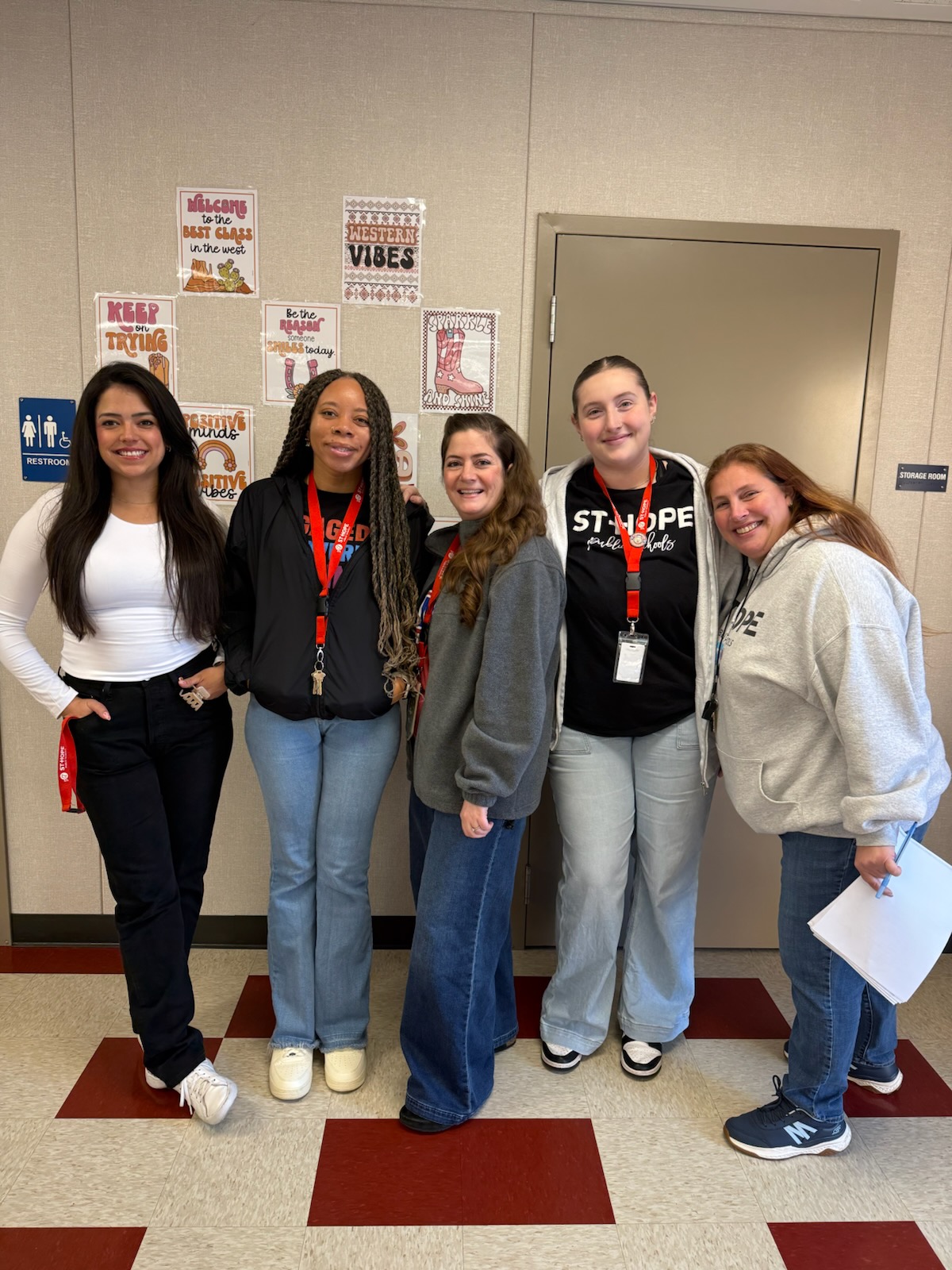
After enduring years of bad “representation” and divisive behavior, Beth Simonton (center) and a majority of educators at St. HOPE charter schools in Sacramento are ready to vote the SCTA union out.
SACRAMENTO, CA – A majority of educators for charter school operator St. HOPE Public Schools are supporting a legal effort that may not only free them from the control of Sacramento City Teachers Association (SCTA) union officials, but may soon free charter school teachers across the state from the onerous California labor bureaucracy.
With free assistance from the National Right to Work Legal Defense Foundation, St. HOPE educator Beth Simonton filed a union decertification petition in January seeking a vote among her colleagues to oust the SCTA union. SCTA is an affiliate of the California Teachers Association (CTA) union and the National Education Association (NEA) union — the latter of which is headed by the radical Becky Pringle.
Simonton filed her petition at the National Labor Relations Board (NLRB), the agency tasked with enforcing federal labor law for most private sector employees. That task includes administering votes to install (or “certify”) and remove (or “decertify”) unions.
The work unit covered by the petition includes over 50 teachers from PS7 Elementary School, PS7 Middle School, and Sacramento Charter High School. Because a majority of teachers in the unit signed the petition, the NLRB should promptly approve and schedule a decertification election.
“SCTA union officials have been extremely divisive and have not had a positive impact on teachers, students, or the St. HOPE community as a whole,” commented Simonton.
“They’ve spent much more time trying to demonize school leadership than simply standing up for our interests. I’m proud to represent the majority of educators at St. HOPE who are standing up and saying ‘enough is enough.’”
SCTA Union Bosses Cause Discord in Sacramento Schools
The SCTA first gained monopoly bargaining power over the charter system in 2018 in a process overseen by the California Public Employment Relations Board (PERB). That agency foisted the union on educators through a mandatory “card check” process that bypassed any secret ballot vote. The PERB is notorious, even compared to the NLRB, for its bias in favor of union bosses and against the rights of employees opposed to union affiliation. By 2021, St. HOPE teachers banded together and petitioned for a union decertification vote, but SCTA union officials filed misconduct charges and got the PERB to block the vote under the PERB’s extreme “blocking charge” regulations.
These mandate that any union boss allegations be assumed true, even if there is no evidence to support them. As a result, the teachers were never allowed to cast votes on whether to remove the union.
Petition: Charter School Not Properly Under Authority of CA Labor Bureau
This time, with National Right to Work Foundation legal assistance, the teachers filed their decertification petition with the NLRB instead of the extremely biased California PERB. Foundation staff attorneys believe, contrary to the wishes of the SCTA union officials, that California charter school employees fall under the jurisdiction of the National Labor Relations Act.
This would allow the decertification to take place under NLRB rules. While far from perfect, they are not as rigged as the PERB’s kangaroo courts. Not only does U.S. Supreme Court precedent support the argument that the NLRB is the proper venue for this petition, but in recent years Foundation attorneys have successfully filed multiple decertification petitions at the NLRB for public charter school employees in other states.
Statewide Impact Possible
“St. HOPE educators serve some of Sacramento’s most underprivileged young people, and they deserve to have their voices in the workplace heard,” commented Mark Mix, National Right to Work Foundation president. “California’s legislature and administrative state are deep in the pockets of CTA teacher union bosses, who overwhelmingly seek to further their own interests and power over the rights of educators themselves.
“We at the Foundation hope that Ms. Simonton and her colleagues’ effort to break free of both CTA union officials and the onerous California labor bureaucracy is just the first step in achieving greater freedom for charter school educators across the Golden State,” commented Mix.
Phoenix Logistics Workers Send Teamsters Bosses Packing With Successful Petition for Decertification
Medical equipment operators supporting Fort Dix overwhelmingly vote out Teamsters Local 35 after being ignored for years
Fort Dix, NJ (July 6, 2026) – Employees at Phoenix Logistics, LLC in Fort Dix have successfully regained their independence from International Brotherhood of Teamsters union bosses. This came as a result of employee Nicholas Rapa filing a petition with the National Labor Relations Board (NLRB), which called for a “decertification” election to remove Teamsters Local 35 as the exclusive bargaining “representative” of Rapa and his coworkers, medical equipment operators assigned to Fort Dix for training.
The NLRB is the federal agency responsible for enforcing federal labor law, a task that includes administering elections to install (or “certify”) and remove (or “decertify”) unions. The petition, which Rapa filed with assistance from National Right to Work Foundation staff attorneys, surpassed the threshold of signatures necessary to trigger a decertification vote.
The election was administered on June 17, and the vast majority of workers voted to remove Teamsters bosses from power. New Jersey does not have state Right to Work protections, which means the union bosses at Phoenix Logistics were able to exercise both of their government-granted forced unionism powers: the ability to force workers into a contract they may not want (monopoly bargaining), and the ability to force workers to pay dues or fees to the union in order to keep their jobs (forced dues).
Successful Decertification Latest Blow to Teamsters Power
The election was certified by the NLRB on June 26, meaning that Rapa and his coworkers are now officially free from both of these abuses by Teamsters union officials. This comes after officials from Teamsters Local 35 had neglected these employees, despite supposedly “representing” the workers for over five years.
In the last few years, decertification efforts have been on the rise. This successful petition was the latest in a long line of decertification efforts specifically against Teamsters officials. Recent NLRB statistics suggest no union faces more decertification petitions than the Teamsters.
“Around the country, workers are questioning union bosses’ priorities, as those officials demonstrate that they are out of step with the needs of the workers they supposedly ‘represent,’” said National Right to Work Foundation President Mark Mix. “We are proud to have supported Mr. Rapa and his coworkers as they exercise their individual right to refuse union power.”
Sioux City Hospital Nurses Win Vote to Eject UFCW Union Bosses
Labor Board certifies election result; 191 registered nurses officially free of unwanted union at UnityPoint Health – St. Luke’s – Downtown location
Sioux City, IA (July 1, 2026) – Registered nurses at UnityPoint Health – St. Luke’s – Downtown hospital have successfully voted to remove United Food and Commercial Workers (UFCW) Local 222IN union officials from their workplace. The nurses’ “decertification” effort was spearheaded by nurse practitioner Timaree Henneman, who filed a petition with the National Labor Relations Board (NLRB) on May 26, seeking a decertification election to end the UFCW’s unwanted monopoly control over the hospital’s registered nurses. The nurses’ petition was filed with free legal aid from National Right to Work Foundation staff attorneys.
The NLRB is the federal agency responsible for enforcing federal labor law, a task that includes administering elections to install (or “certify”) and remove (or “decertify”) unions. Henneman’s petition was signed by enough of her coworkers to trigger the NLRB to administer a secret-ballot election among all 191 nurses, including full-time, regular part-time, and PRN registered nurses employed at the UnityPoint Health – St. Luke’s – Downtown facility.
The election, which took place on June 18, saw the nurses vote 80-71 to end the presence of UFCW Local 222IN at their hospital. The NLRB certified the election result on June 30, formally revoking the UFCW’s status as the nurses’ monopoly “representative.”
Iowa is one of 26 states with a Right to Work law, which safeguards workers by making union membership and dues payment strictly voluntary. However, even in Right to Work states, federal law grants union officials the power to impose exclusive “representation” over every employee in a work unit—including those who never voted for, joined, or supported the union—dictating their terms and conditions of employment.
“We congratulate this group of nurses on exercising their legal right to remove unwanted UFCW union bosses from their hospital,” commented National Right to Work Foundation President Mark Mix. “Ultimately, this case is a reminder of the twin powers that have been granted to union officials to the detriment of the rights of individual workers: forced union dues and union boss monopoly bargaining powers.
“While Iowa’s popular Right to Work law protects these nurses and others from being forced to fund a union they oppose, under federal law employees—whether or not they enjoy Right to Work protections—can be forced under the so-called ‘representation’ of union officials they oppose,” added Mix. “We look forward to the day when every individual employee has the freedom to decide for themselves whether or not to associate with a union.”
Wisconsin Painter Files Federal Charges Against Painters and Trades Union for Unlawful Forced Membership, Dues Deductions
IUPAT union bosses lied to worker, claiming union membership and dues payment authorization were mandatory for employment
Waukesha, WI (June 23, 2026) – Caryn Johnson, an employee of Olympic Companies, has filed charges at the National Labor Relations Board (NLRB) against International Union of Painters and Allied Trades (IUPAT) District Council 7. The charges state that IUPAT union officials unlawfully coerced her into formal union membership and dues payment by claiming, contrary to federal law, that both were mandatory conditions of her employment at Olympic.
The charges were filed at the NLRB with free legal aid from the National Right to Work Legal Defense Foundation. The NLRB is the federal agency responsible for enforcing the National Labor Relations Act, a task that includes adjudicating labor disputes between union officials, employers, and individual employees.
According to the charges, Johnson was coerced into “joining” the union after IUPAT District Council 7 union bosses told her that she had to be a dues-paying union member in order to be employed at Olympic Companies. Under longstanding federal law, full union membership cannot be required, nor can an employee be required to sign a card authorizing the deduction of union dues from her paycheck, which IUPAT officials also demanded Johnson sign to be employed.
Johnson resigned her union membership after she found out that IUPAT union officials misled her about her legal rights. Johnson’s charges state that despite validly resigning her union membership, IUPAT continued to extract dues from her wages, apparently relying on the “dues authorization” form she was coerced into signing. Union officials are claiming she cannot cut off dues for approximately eight months, and even then must provide additional written revocation during the union’s arbitrary revocation window.
Wisconsin is one of the 26 states with a Right to Work law, which protects workers by making union affiliation and dues payment strictly voluntary. This means, not only could dues deductions not be required for employment, but, because of the Right to Work, no union payments of any form can be mandatory as a condition of employment.
“Time after time, union officials turn to lies, threats, and coercion to expand their power and fill their coffers, rather than attempt to convince workers to voluntarily support union activities,” commented National Right to Work Foundation President Mark Mix. “Ms. Johnson’s experience is not an isolated case, but is one Foundation staff attorneys see repeated across the country by union officials who think their government-granted monopoly privileges sanction them to violate the rights of those they claim to ‘represent.’”
Funeral Home Workers Win Vote to Bury Unwanted Teamsters ‘Representation’
The following article is from the National Right to Work Legal Defense Foundation’s bi-monthly Foundation Action Newsletter, March/April 2026 edition. To view other editions of Foundation Action or to sign up for a free subscription, click here.
Despite union attempt to block election, workers win freedom with Foundation aid

Noah Watry and his fellow employees grew tired of Teamsters bosses’ self-serving agenda — which was especially inappropriate within the solemn setting of Krause Funeral Home.
MILWAUKEE, WI – Employees at three Milwaukee-area Krause Funeral Home & Cremation Services locations have freed themselves from the unwanted “representation” of Teamsters Local 344 union officials.
The workers’ triumph came after Krause management withdrew recognition of the Teamsters based on a petition showing that the union had lost majority support among workers. Krause employee Noah Watry submitted this petition and later defended it with free legal aid from National Right to Work Foundation staff attorneys.
Teamsters Bosses’ Dismal and Disrespectful Actions Angered Workers
While Teamsters union bosses initially tried to block the ouster, claiming Krause committed an unfair labor practice by withdrawing recognition, union officials quickly backed down after Foundation staff attorneys filed a Motion to Intervene with the National Labor Relations Board (NLRB) on Watry’s behalf.
Watry had submitted a “decertification petition” to the NLRB, in which he and his coworkers requested that the agency hold a vote to remove the Teamsters union. That petition contained more than enough signatures from employees in his work unit to trigger an election under NLRB rules.
Krause workers expressed that Teamsters union officials had communicated poorly and dragged their feet on negotiating contracts, but these were far from the only reasons they wanted the union gone. Some also found it very disrespectful that Teamsters officials orchestrated strikes along the sidewalk when Krause held funerals — including funeral proceedings for a child and a WWII veteran.
Watry shared a copy of his employee petition with Krause officials, who, following the NLRB’s Levitz Furniture Co. precedent, ended recognition of the Teamsters after seeing that the petition signers also requested that Krause withdraw recognition.
Teamsters Attempt to Delay the Inevitable
Even though Krause had followed NLRB case law in withdrawing, Teamsters union agents sought to block the employee petition and the employer’s withdrawal by filing unfair labor practice charges against Krause with the NLRB, alleging that the company had withdrawn recognition illicitly. This prompted an NLRB Regional Office to begin prosecuting the funeral home company, but Watry defended the withdrawal that he and his coworkers had requested by filing a Motion to Intervene.
Eventually, NLRB officials set the case for a hearing before an Administrative Law Judge. Almost immediately, Teamsters lawyers withdrew all charges against Krause, likely knowing that a hearing would reveal the meritless nature of union officials’ unfair labor practice charges. This effectively ended the Teamsters’ presence at Krause’s facilities.
“This case illustrates clearly the lengths that union officials will go to in order to hold on to power in a workplace where workers would prefer to be independent,” commented National Right to Work Foundation Vice President Patrick Semmens. “The Foundation is pleased to have been able to aid Mr. Watry and his colleagues in navigating the convoluted federal labor bureaucracy that places hardworking Americans like them at a disadvantage whenever they seek to exercise their rights.”
Right to Work Must Be Expanded and Defended
“While this case worked out in Mr. Watry’s favor, it’s important to remember that he and his coworkers have the benefit of Right to Work and could not be forced to subsidize the same Teamsters union that was trying to trap them,” Semmens added. “That is why every American deserves Right to Work protections, and even in states where Right to Work exists, it must be defended.”
NC Miners Fight Biden-Era Policy Trapping Workers in Unions They Oppose
The following article is from the National Right to Work Legal Defense Foundation’s bi-monthly Foundation Action Newsletter, March/April 2026 edition. To view other editions of Foundation Action or to sign up for a free subscription, click here.
New majority at federal labor board can eliminate ‘blocking charge’ policy
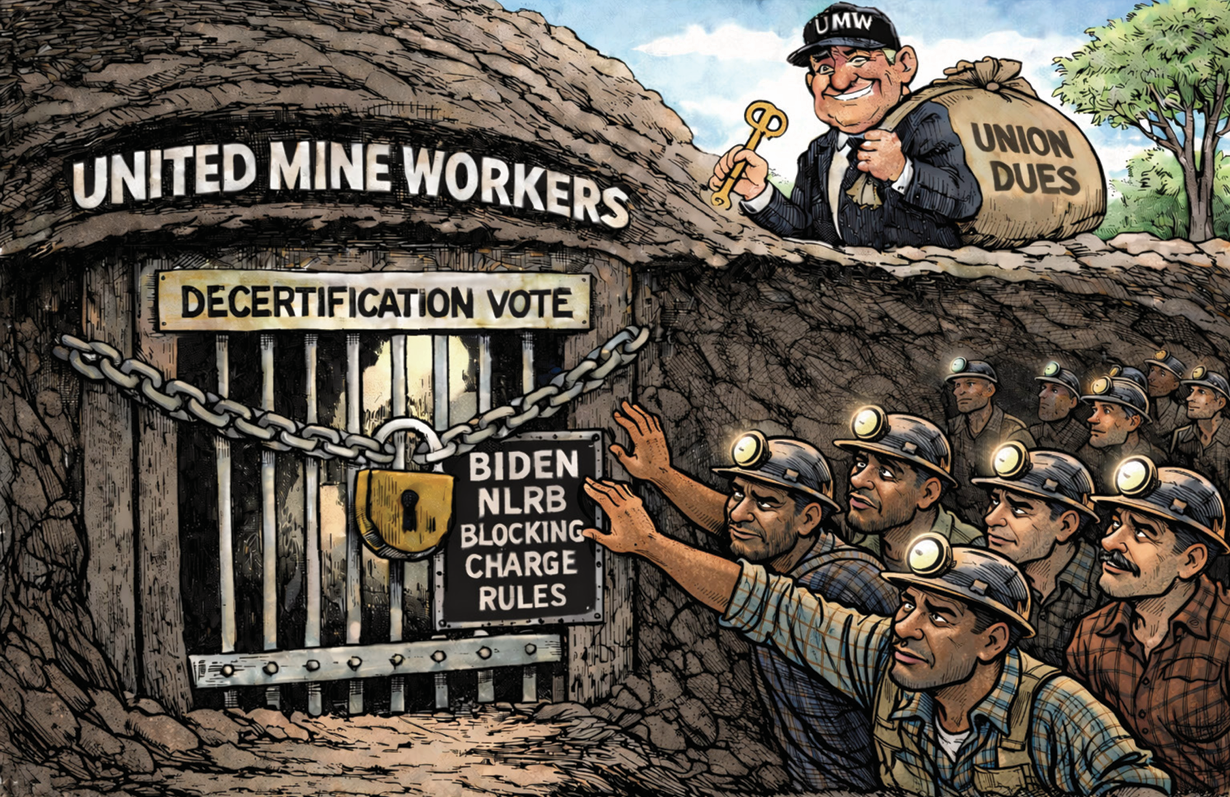
The Biden NLRB’s “blocking charge” policy serves only to trap workers under union “representation” that they’ve rightfully sought a vote to oust. But courageous miners in North Carolina are now taking a stand against this unfair policy.
SPRUCE PINE, NC – Known by the moniker “The Mineral City,” Spruce Pine is famous for being the origin of a large amount of the world’s high-purity quartz, a key component in manufacturing semiconductors. But now, it’s also the source of a legal challenge that could reshape the American labor law landscape in favor of worker freedom.
Blake Davis, a miner for The Quartz Corp., is challenging a Biden era National Labor Relations Board (NLRB) policy that is blocking him and his coworkers from voting in a worker-requested election to remove United Mine Workers (UMW) union officials from their workplace. This policy, called the “blocking charge” policy, hands union officials the power to stymie the union removal (or “decertification”) process simply by filing unproven, unsubstantiated, or unrelated “unfair labor practice” charges at the NLRB alleging employer misconduct.
Filing: ‘Blocking Charge’ Policy Clashes With Federal Law and Workers’ Rights
Davis collected and submitted a petition for a decertification vote in late 2025, which contained enough of his colleagues’ signatures to trigger a vote under NLRB rules. However, regional NLRB officials have blocked the vote due to the NLRB’s current blocking charge policy.
Davis, with the help of Right to Work attorneys, has now submitted a Request for Review to the NLRB in Washington, DC, which asks the Board to overturn the blocking charge policy and let him and his coworkers vote on whether to remove the UMW union. Since his brief was submitted, the U.S. Senate approved two new presidential appointees to the NLRB, meaning the Board now has a “quorum” and can decide this case and others.
Davis’ Request for Review argues that the NLRB’s blocking charge policy directly conflicts with the text of the National Labor Relations Act (NLRA), the federal law that the NLRB is responsible for enforcing. Davis’ brief contends that the rule lets self-interested union officials unilaterally block an election, even though the NLRA explicitly orders the Board to conduct an election whenever employees submit a valid decertification petition.
Davis’ brief also maintains that the blocking charge rule violates the Administrative Procedure Act (APA) because it is arbitrary and fails to accomplish even its own stated goals. For example, the Board argues the rule is necessary to stop “coercive elections” from happening, even though the massive advantages it gives to union bosses in the election process can hardly be considered fair.
The National Right to Work Foundation has long advocated for the NLRB to return to the Election Protection Rule, which prevented many blocking charge delay tactics before the Biden NLRB overturned it in 2024. Under the Election Protection Rule, allegations of misconduct related to a union decertification election could not block employees from exercising their right to vote, and in most cases the rule permitted the vote tally to be released before litigation over the election could occur.
Trump NLRB Can Empower Independent-Minded Workers
“The NLRB’s ‘blocking charge’ policy serves only to let union officials stop the workers they claim to ‘represent’ from making a free choice about whether they want that union to represent them,” commented National Right to Work Foundation Vice President and Legal Director Bill Messenger. “Mr. Davis and his coworkers are just the latest victims of these bureaucratic policies that trap workers in forced union ranks.
“If President Trump’s new NLRB appointees are serious about putting American workers back in control of their own livelihoods, reversing this union boss power giveaway is an excellent place to start,” Messenger added.
Wyoming Wells Fargo Bank Branch Employees Latest Group to Win Freedom from Unwanted CWA Union Bosses
Once CWA union officials’ attempt to block election failed, union once again conceded defeat rather than contest decertification election
Casper, WY (June 11, 2026) – Employees at a Wells Fargo branch in Casper have successfully regained their independence from Communications Workers of America (CWA) union bosses. The effort to remove the union was initiated when bank employees filed a petition with the National Labor Relations Board (NLRB) seeking a “decertification” election to remove the CWA as the bargaining representative at their Wells Fargo branch. The petition was filed with free legal aid from the National Right to Work Foundation.
The NLRB is the federal agency responsible for enforcing federal labor law, a task that includes administering elections to install (or “certify”) and remove (or “decertify”) unions. The decertification petition was signed by the vast majority of employees at the Wells Fargo branch, easily surpassing the required threshold of signatures needed for the NLRB to schedule a decertification vote.
Despite the overwhelming support for decertifying, CWA officials initially attempted to disenfranchise the employees using the NLRB’s “blocking charge” policy, which allows unions to delay, or even block entirely, worker-demanded decertification votes with unproven allegations against an employer. However, when Foundation staff attorneys pushed back against the blocking charges, the CWA dropped them, likely because the NLRB would have otherwise dismissed them as meritless.
At that point, with a decertification vote unavoidable, CWA union bosses simply “disclaimed” representation at the branch rather than face an overwhelming election defeat. Now the NLRB has accepted the disclaimer and formally revoked the union’s certification as the workers “exclusive representative.”
This year alone, Foundation staff attorneys have assisted successful Wells Fargo employee efforts to remove unwanted CWA union bosses in Spring Hill and Bradenton, Florida, Seaside Park, New Jersey, and Wilmington, Delaware. Another group of workers in Apex, North Carolina, also successfully removed the union in March. This is now the fifth Foundation-assisted case of Wells Fargo employees removing unwanted CWA union bosses from their branch.
“The Foundation is proud to assist Wells Fargo employees in Casper and other branches across the country seeking to exercise their right to free themselves from unwanted unions,” commented National Right to Work Foundation President Mark Mix. “As this string of wins by Wells Fargo employees seeking to remove the CWA demonstrates, these employees that have seen the union up close continue to come to the conclusion that they are better off without the CWA at their workplace.”
GWU Hospital Nurses Ask National Labor Relations Board to Overturn Policy Blocking Vote to Remove Union
Appeal: ‘Blocking Charge Rule’ violates text of federal law and was wrongly applied to block election requested by hundreds of nurses
Washington, DC (June 3, 2026) – Following a petition signed by hundreds of registered nurses and healthcare professionals at George Washington University Hospital, the nurse who filed the petition has asked the National Labor Relations Board (NLRB) to stop using its non-statutory “blocking charge” policy to block the GWU Hospital employees from voting in an election to remove District of Columbia Nurses Association (DCNA) union officials from power at the facility.
In April the GWU hospital workers, led by nurse Elizabeth Abraha, filed a decertification petition with the NLRB to free themselves from DCNA representation. The NLRB is the federal agency responsible for enforcing the National Labor Relations Act (NLRA), a task that includes administering elections to install (or “certify”) and remove (or “decertify”) unions.
After Abraha’s petition was filed, DCNA union bosses moved to block the nurses’ election with unproven “unfair labor practice” charges against the Hospital. Abraha’s Request for Review argues that NLRB Regional officials accepted the DCNA’s charges without due process, stating that Abraha’s petition was suspended “based on ULP charge proceedings without holding a public hearing or even permitting Petitioner to review the charges.”
Abraha’s Request for Review contends the NLRB’s blocking charge policy is inconsistent with the text of the NLRA: “Allowing an interested, third party to unilaterally stop an election proceeding violates NLRA Section 9 [which] states that ‘whenever a petition shall have been filed’ ‘the Board shall investigate such petition’ and if the Board finds ‘a question of representation exists, it shall direct an election by secret ballot.’”
The Request for Review points out that the NLRA does not grant the NLRB the authority to invent rules to stymie worker-requested decertification elections. Moreover, it argues the NLRB Region denied the petitioner due process by refusing to hold a hearing or provide copies of the charges being used as pretext for blocking the decertification vote.
“The text of the NLRA unambiguously states that employees have the right to hold decertification elections to remove an unwanted union from their workplace,” commented National Right to Work Foundation President Mark Mix. “The NLRB should be defending employee free choice, not inventing policies that protect incumbent union bosses from being voted out by rank-and-file workers.
“Ending the biased Biden-era blocking charge policy would be one of the most pro-worker changes the new Board majority could and should take,” added Mix.





