
Wonderful Nurseries Workers Hit UFW Union with Charges Detailing Fraudulent Union Campaign, Illegal Discrimination
Charges: Union gained “majority status” through false pretenses and union agents are cracking down on workers that express opposition
Bakersfield, CA (April 26, 2024) – Claudia Chavez and Maria Gutierrez, two workers at food and drink company Wonderful Nurseries LLC’s Wasco, CA, grapevine nursery, have filed charges against the United Farm Workers (UFW) union. They maintain that UFW agents fraudulently obtained membership cards from employees and later used this as a basis to demand monopoly-bargaining power over Wonderful employees statewide. Chavez and Gutierrez filed their charges at the California Agricultural Labor Relations Board (ALRB) with free legal aid from National Right to Work Foundation staff attorneys.
The ALRB is the California state agency responsible for governing labor relations in the state’s agricultural sector, which includes overseeing union attempts to gain bargaining control at farms and other facilities. Chavez and Gutierrez’s charges detail that UFW union officials installed themselves at Wonderful Nurseries through “card check,” which bypasses workers’ right to vote in secret on the union and instead relies on membership (or “authorization”) cards collected by union officials, sometimes under dubious circumstances.
The card check process lacks the security of a secret ballot vote, and exposes workers to intimidation and manipulation from union officials who seek to collect enough cards to claim “majority support” among workers. Under ALRB rules, a union that presents the agency with cards obtained from a majority of workers is immediately certified as the monopoly bargaining agent, a status that can only be challenged after the fact.
Chavez and Gutierrez argue that UFW union officials “by artifice, fraud, deceit, misrepresentation, and/or coercion” got them and many of their coworkers to sign membership cards for the union and the union falsely “represent[ed] itself as having obtained the support of a majority of the employees” afterward. Chavez and Gutierrez also contend that UFW bosses are now illegally forbidding employees from revoking the fraudulently-obtained cards, and are harassing and retaliating against employees who oppose the union.
“UFW union officials deceived us just so they could gain power in our workplace,” Chavez and Gutierrez commented. “Instead of just letting us vote in secret on whether we want a union, they went around lying and threatening to get cards and now are cracking down on anyone who speaks out against the union. We hope the ALRB listens to us and prosecutes the union for its illegal acts.”
Union Officials Spread Lies About Union Cards and Engaged in Discrimination to Obtain Signatures
Chavez and Gutierrez’s charges describe multiple fabrications – and even discriminatory behavior – that UFW union bosses used to get employees to sign authorization cards, including “representing that certain COVID-19-related public benefits available to farmworkers required signatures on union membership cards…that union membership cards were not, in fact, union membership cards to be used in any UFW organizing efforts…presenting to strictly Spanish-speaking discriminatees union membership cards only in English…[and] presenting to illiterate discriminatees union membership cards and misrepresenting their content and/or significance.”
With the union installed and UFW agents not letting workers revoke their illicitly-obtained memberships in the union, Chavez and Gutierrez note that UFW union officials are now “engaging in a campaign of harassment, libel, slander, and intimidation against [employees who are] exercising their right of free speech and/or protest under [California labor law] to oppose UFW representation.” News reports suggest that scores of Wonderful Nurseries workers have engaged in outdoor demonstrations against the union, declaring “We don’t want a union, listen to our voices, don’t ignore us.”
In addition to the ALRB charges, Chavez and Gutierrez, along with a dozen other coworkers, seek to intervene in the ongoing ALRB case in which Wonderful Nurseries is challenging the union’s card check majority “certification” as improperly based on cards collected through fraud and other improper means. Foundation staff attorneys represent the group of workers seeking to intervene in that case to defend their right not to be placed under union monopoly control as a result of UFW organizers’ illicit tactics.
“UFW union officials have treated Wonderful Nurseries workers as pawns to be used in their pursuit of power, deceiving them with no regard for their rights and now engaging in retaliation against those who exercise their free speech rights against the union,” commented National Right to Work Foundation President Mark Mix. “Their situation above all shows the glaring flaws of the ‘card check’ process, in which workers are denied a chance to vote in secret on a union and are left exposed to a multitude of illegal union tactics.”
Another MIT Grad Student Hits GSU Union with Federal Labor Charges for Illegally Seizing Money for Radical Union Agenda
Charges: Union officials imposing so-called ‘window period’ restriction to forbid civil engineering grad student from cutting off dues for politics
Boston, MA (April 26, 2024) – Following five Jewish students filing federal religious discrimination charges against the union, the MIT Graduate Student Union (GSU-UE) is now facing new federal unfair labor practice charges from civil engineering graduate student Katerina Boukin. Boukin’s charges, filed at the National Labor Relations Board (NLRB) with free legal aid from the National Right to Work Legal Defense Foundation, maintain that union officials are unlawfully seizing money from her research compensation to support union political activities she abhors.
Boukin seeks to enforce her rights under the 1988 Right to Work Foundation-won CWA v. Beck Supreme Court decision. The Court held in Beck that union officials cannot force those under their control to pay dues or fees for union expenses not directly related to collective bargaining, such as political expenses. Nonmembers who exercise their Beck rights are entitled to an independent audit of the union’s finances and a breakdown of how union officials spend forced contributions.
Beck rights are only relevant in non-Right to Work jurisdictions like Massachusetts, where union officials have the legal power to compel the payment of some union fees in a unionized environment. Because of controversial rulings by the Obama and Biden NLRBs, graduate students at private educational institutions like MIT are treated as “employees” who can be subjected to forced union representation and mandatory payments. In jurisdictions that have Right to Work protections, in contrast, union membership and all union financial support are strictly voluntary.
“GSU union officials are going above and beyond what is legal and are forcing me to pay for their political activities, including their opposition to Israel and promotion of Leninist-Marxist global revolution, that I find deeply offensive,” commented Boukin. “The GSU’s political agenda has nothing to do with my research as a graduate student at MIT, or the relationships I have with my professors and the university administration, yet outrageously they demand I fund their radical ideology.”
Union Still Seizing Dues for Politics Under Guise of ‘Window Period’ Restriction
According to Boukin’s charges, she and other graduate students resigned their memberships in the GSU union, revoked their dues “checkoff” authorizations, and objected under Beck to paying anything going toward GSU’s “political and non-representational agenda and expenditures.”
Despite these requests, the charges note, union bosses have “refused to process those Beck objections, refused to immediately reduce the amount of dues and fees collected from Charging Party’s and other graduate students’ [compensation], refused to stop the dues checkoff, and refused to provide Charging Party” with an independent audit explaining the union’s expenses and reduced fee calculation.
Instead, a GSU vice president told Boukin that she had missed an annual “window period” in which to exercise her Beck rights and that her objections would not be considered until November 2024. “In fact, the UE union has adopted an unlawfully restrictive Beck objection policy, precisely to diminish and destroy [the students’]…rights,” says the charge.
The charges note that the union’s unlawful dues scheme restrains and coerces the graduate students from exercising their right under the National Labor Relations Act (NLRA) to refrain from union activity. MIT is also charged for its role in enforcing the union scheme and continuing to collect dues.
Previously, another MIT graduate student, Will Sussman, filed NLRB charges against the UE union for violating his rights under Beck. Sussman filed the charges on his own but later obtained free legal representation from the National Right to Work Foundation.
GSU Also Faces Religious Discrimination Charges, May Be Violating Past Beck-Related Settlement
Sussman’s case concluded because UE settled with the NLRB. As part of that settlement, GSU union officials are required to “notify [all graduate students] of your rights under…Communications Workers v. Beck” and email notices informing students of those rights and post a notice for 60 days. Despite still being within the 60-day notice-posting period, as Boukin’s case shows, GSU officials appear to be violating the spirit if not the letter of that settlement.
Boukin’s unfair labor practice charges come as federal discrimination charges are pending at the Equal Employment Opportunity Commission (EEOC) for five Jewish graduate students who requested religious accommodations to paying money to the GSU union. Among other things, these students oppose the union’s advocacy for the anti-Israel “Boycott, Divestment, and Sanctions” (BDS) movement.
“Freedom of association is apparently a foreign concept to GSU union officials, who are flouting layers upon layers of federal law to compel students to fund their radical political agenda,” commented National Right to Work Foundation President Mark Mix. “However, both this case and Foundation attorneys’ case for the five Jewish MIT graduate students show on a deeper level that the choice to provide support to a union should rest solely with workers, who may have sincere religious, political, or other objections to funding any or all of a union’s activities.”
UAW Faces Federal Charges for Threatening Philly Dometic Employees with Termination If They Go to Work
Charge says union officials sent mass text threatening termination for continuing to work.
Philadelphia, PA (April 23, 2024) – United Auto Workers (UAW) officials at the Philadelphia-area plant of auto accessory manufacturer Dometic are facing new worker-filed charges for sending a mass text to employees illegally threatening their employment if they choose to work during the strike. The new charges, which now await review by the National Labor Relations Board (NLRB), come after several employees hit the UAW with NLRB charges accusing the union of imposing unlawful disciplinary procedures on them despite their resignation from the union, and illegally seizing money from their paychecks.
Dometic employee Mario Coccie filed the charges with free legal aid from the National Right to Work Foundation. The NLRB is the federal agency responsible for enforcing the National Labor Relations Act (NLRA), the federal law that governs private sector labor relations in the United States. Under the NLRA, American private sector workers have a right to refrain from union activity, and the U.S. Supreme Court recognized in General Motors v. NLRB the right of employees to resign union membership during a strike and continue working.
Coccie, one of the seven workers who originally filed charges against the UAW, included details about the mass text in his charges. According to his filing, the new threats from UAW bosses were directed beyond those who filed charges against the union initially and threaten everyone who choose to work during the strike with losing their jobs and being “judged” by union militants at an internal union trial.
“The information in this text reveals union officials’ real intentions, which is to hurt anyone willing to stand up for themselves,” said Mario Coccie. “What is happening in this case is completely unjust.”
UAW Union Officials Threaten Workers for Desiring to Leave
The UAW’s mass text message, apparently sent by union official Mike Poust, warns workers that “There are and will be consequences for crossing the line becoming a scab [sic] you will be put on trial you will be judged by your peers…[you will] have no right to hold or acquire any [union-controlled] job within the plant.”
These threats come in addition to intimidation detailed by seven Dometic workers in past charges, which explained that a union steward told each of them during a September 8, 2023, meeting that any employee who crossed the UAW’s picket line during the strike would be subject to internal union charges, fined, and ultimately terminated. Despite resigning their union membership and no longer being legally subject to internal union discipline, UAW union officials notified each worker in December 2023 that the union had started proceedings against them and their presence would soon be required at an internal union trial.
The seven employees also charged that union officials ignored their rights as nonmembers under the Right to Work Foundation-won CWA v. Beck Supreme Court case, and took full union dues (including dues for union political activities) from their paychecks even after they had resigned their membership.
Because Pennsylvania lacks Right to Work protections for its private sector employees, union officials can impose contracts that force workers who have refrained from formal union membership to pay fees to the union as a condition of keeping their jobs. However, as per Beck, this managing fee cannot include any money that funds a union’s political or lobbying activities. Beck also requires union officials to provide financial disclosures to workers who send a Beck notice.
“UAW union officials are waging a multi-million-dollar propaganda campaign to bring more workers into their ranks, but Mr. Coccie and the workers at the Philadelphia Dometic plant represent the reality of what workers experience under the UAW’s control,” Mark Mix, president of the Right to Work Foundation said. “This is just the latest of many examples of the illegal retaliation that workers face when they act independently and refuse to tow the union line. The National Right to Work Legal Foundation stands ready to defend these workers’ rights and the rights of others targeted by power-hungry union bosses.”
Tire Wholesaler Employees Force RWDSU Union Out of 15 Locations
The following article is from the National Right to Work Legal Defense Foundation’s bi-monthly Foundation Action Newsletter, January/February 2024 edition. To view other editions of Foundation Action or to sign up for a free subscription, click here.
RWDSU union officials abandon 500+ employee unit ahead of vote at tire wholesaler
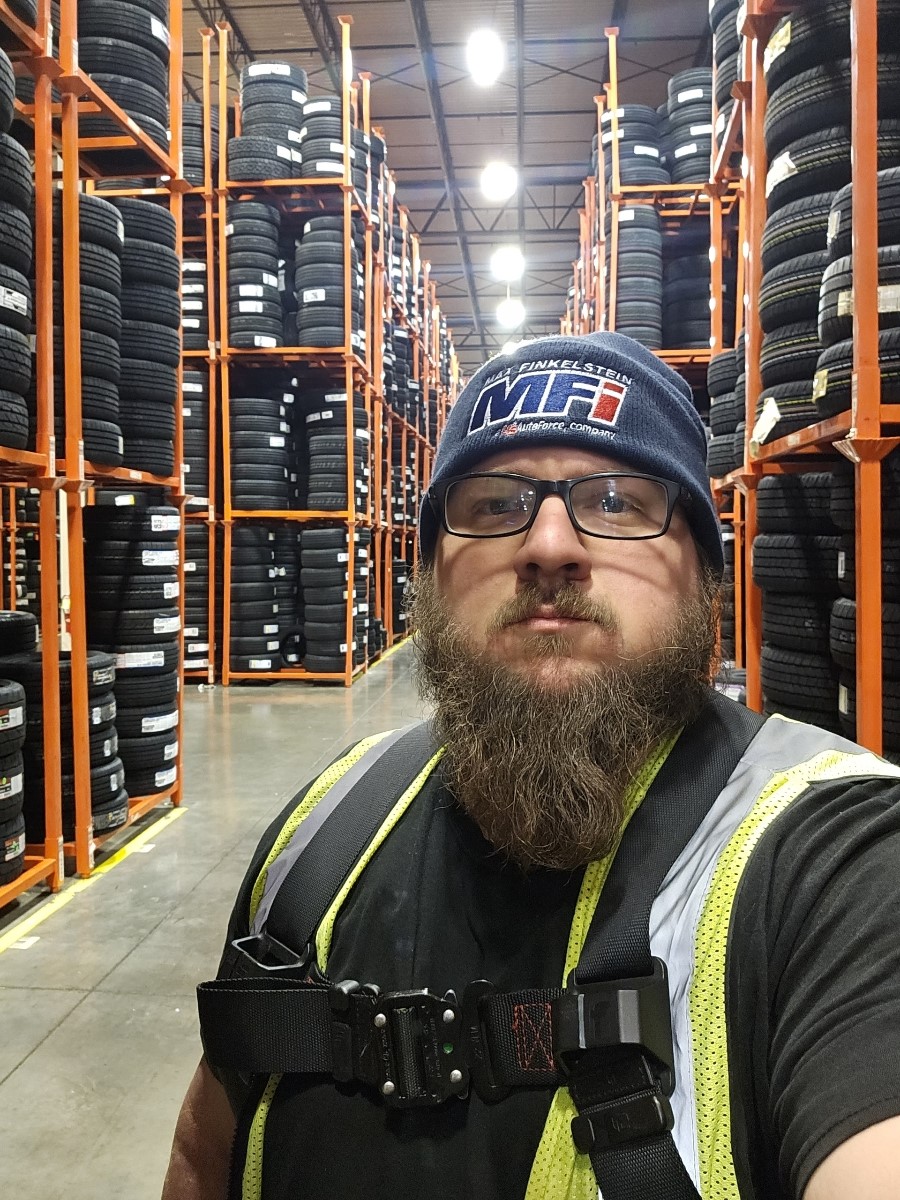
Tire-d of the RWDSU: Chris Dorney submitted a huge number of signatures from his coworkers at tire wholesaler Max Finkelstein when petitioning the NLRB for a vote to remove the RWDSU union.
WINCHESTER, VA – The Biden National Labor Relations Board (NLRB), which includes among its members two former union bosses from the Service Employees International Union (SEIU), is pursuing an agenda that hasn’t exactly been making it easy for workers to vote out a union they don’t want. But that hasn’t stopped workers across the country from going to extraordinary lengths to kick out unions that don’t serve their interests.
In October 2023, Chris Dorney, a Winchester, VA-based employee of tire wholesaler Max Finkelstein, kick-started a cross-country effort to vote the Retail, Wholesale and Department Store Union (RWDSU) out of 15 warehouse facilities across the eastern United States. This work unit included more than 500 employees across Virginia, Maryland, Massachusetts, Pennsylvania, New York, New Jersey, Vermont, Maine, and Connecticut.
Virginia Worker Mustered Strong Showing on Petition for Union Ouster Vote at Tire Wholesaler
With free legal aid from the National Right to Work Foundation, Dorney submitted a petition to the NLRB containing more than enough employee signatures to trigger a vote to remove the union from the large unit.
While Dorney and his fellow Virginia employees enjoyed the Right to Work freedom to opt-out of dues payments to the union, the same couldn’t be said for any of the other employees, all of whom hail from states where dues payments can be mandated as a condition of employment. But voting RWDSU bosses out of power entirely at the tire wholesaler would end the union’s forced-dues power.
“We warehouse workers and drivers at Max Finkelstein may be from many different facilities in many different states, but we are in agreement about one thing: RWDSU union officials don’t represent our interests,” Dorney said of the effort. “It’s our right under federal law to challenge RWDSU’s forced representation power.”
RWDSU Bosses Flee Unit as Union Officials Rack Up Losses Nationwide
However, before the vote could occur, RWDSU union officials disclaimed interest in continuing their monopoly representation powers over the unit, likely to avoid an embarrassing rejection by workers at the ballot box.
Unionized workers are increasingly requesting elections to remove unwanted unions — a potential reason for the Biden NLRB’s efforts to crack down on decertification votes. Additionally, union bosses are increasingly losing these contests. As of last year, filings for union decertification votes had shot up by over 40 percent since 2020. Of decertification elections that occurred, the number which resulted in union bosses losing went up by 72 percent.
“Mr. Dorney and his coworkers’ effort to kick out the RWDSU union, which spanned several states, 15 facilities, and hundreds of workers, is yet another example that workers often want to escape union officials’ one-size-fits-all agenda. It’s also a demonstration that workers will go to great lengths in order to exercise this right,” commented National Right to Work Foundation Vice President Patrick Semmens. “But the Biden NLRB, bent on empowering the President’s union boss political allies, plans to grant unions even more power to defeat workers’ will.”
Buffalo Starbucks Barista Counters NLRB’s Move to Trap Workers in Union
The following article is from the National Right to Work Legal Defense Foundation’s bi-monthly Foundation Action Newsletter, January/February 2024 edition. To view other editions of Foundation Action or to sign up for a free subscription, click here.
Appeals Court brief defends workers’ right to oppose and decertify union
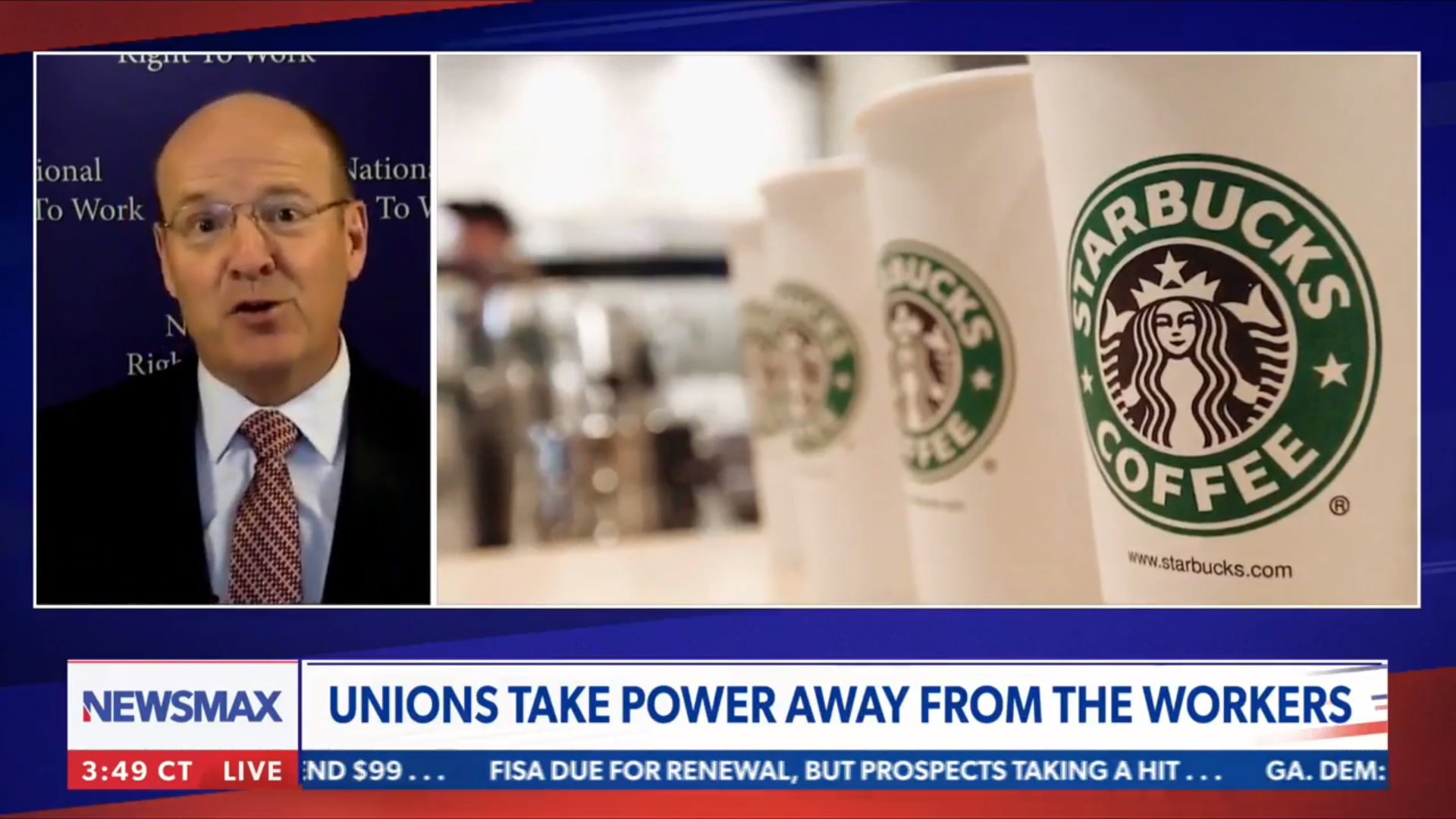
As Mark Mix explained on Newsmax TV, SBWU officials spent millions to infiltrate Starbucks with covert union agitators. That led to some of the first unionized Starbucks stores in Buffalo, NY, but now Buffalo baristas are trying to oust SBWU.
BUFFALO, NY – Although the National Labor Relations Board (NLRB) is charged with neutrally enforcing federal labor law, it has a notorious reputation for strengthening union officials’ power while diminishing the rights of workers opposed to union representation. Even with this biased history, the Biden Labor Board has already established itself as the most radically pro-forced unionism board in history.
The NLRB’s ideological bias is most apparent in its massive campaign to impose coercive unionism on Starbucks workers, while repeatedly blocking and undermining Starbucks employees’ attempts to remove unwanted union representation. While agency officials have approved hundreds of petitions for votes to bring the Starbucks Workers United (SBWU) union in, it has not let any of the roughly 20 worker-backed petitions seeking votes to remove the union advance to an election.
NLRB Cites Workers’ Desire to Oust Union as Reason to Impose Union
The NLRB’s anti-worker tactics have reached a new frontier. The NLRB is now citing a petition to remove the union as a reason why the union should not be removed and should serve as the basis for an injunction against Starbucks. NLRB lawyers are asking the Second Circuit Court of Appeals to overturn a District Court ruling and issue an injunction that would force Starbucks to engage in bargaining talks with the union, despite the fact that the decertification petition proves that a majority of employees at a Buffalo, NY, Starbucks want to throw the union out.
The decertification petition in question was collected by Starbucks barista Ariana Cortes. Cortes sought a vote to remove SBWU from her workplace, but the NLRB has refused to conduct the election. National Right to Work Legal Defense Foundation staff attorneys represent Cortes and Starbucks employees in nine other locations where workers are seeking votes to remove the SBWU. Now staff attorneys have filed a legal brief for Cortes and fellow Buffalo Starbucks employee Logan Karam in the Second Circuit Court of Appeals, countering the NLRB’s latest outrageous maneuver.
Cortes’ brief attacks the NLRB’s strategy as condescending toward workers. It argues the NLRB’s view that Cortes’ decertification must be stopped to protect workers is rooted in the wrongful idea that workers cannot think for themselves and lack independent reasons for wanting to get rid of a union.
Foundation Brief: NLRB Denies Workers’ Agency, Free Choice
“In reality, Cortes collected her petition because of the Union’s anti-employee behavior,” the brief says.
Foundation attorneys also contend in Cortes’ brief that what the NLRB is seeking from the Second Circuit — a 10(j) injunction under the National Labor Relations Act (NLRA) that will force Starbucks managers into working with SBWU union bosses to craft a monopoly bargaining contract — is extreme. Such injunctions can only be ordered when the harm done to workers in their absence would be “irreparable.” Foundation attorneys argue Cortes’ and other employees’ attempts to decertify do not make any injuries suffered by the union “irreparable.”
Dangerous Precedent Set If Court Grants Injunction That Undermines Right to Remove Unwanted Unions
If the Second Circuit grants the NLRB’s request for an injunction on behalf of SBWU union bosses, it would be the first time that a federal court has ordered a Starbucks store to engage in bargaining with union bosses on the basis of an employee’s decertification petition.
“The NLRB is digging an even deeper grave for employees trying to exercise their rights to remove an unwanted union from their workplace,” commented National Right to Work Foundation President Mark Mix. “The Board’s attempt to twist the limited employee rights to throw out a union into a reason to force a union upon employees is a new low.
“Ariana Cortes and Logan Karam are taking a courageous stand to ensure their coworkers aren’t disenfranchised and trapped under a union hierarchy they oppose, and we’re proud to support them,” Mix added.
Federal Lawsuit Hits Guards Union of America for Illegally Forcing DC-Based Security Guard to Pay for Union Politics
Union officials provided contradictory information on amount a guard must pay the union to keep a job
Washington, DC (April 19, 2024) – Rosa Crawley, a DC-based security guard employed by Master Security, has just hit the International Guards Union of America (IGUA) Local 160 with a federal lawsuit, which maintains that full union dues, including dues for union political activities, are being illegally deducted from her paycheck. Crawley filed the complaint in the U.S. District Court for the District of Columbia with free legal aid from National Right to Work Foundation staff attorneys.
Crawley, who with her coworkers provides security services to the Department of Homeland Security’s “Nebraska Avenue Complex,” seeks to enforce her rights under the 1988 Right to Work Foundation-won CWA v. Beck Supreme Court decision. The Court held in Beck that union officials cannot force workers who have abstained from union membership to pay union dues or fees for any expenses not directly germane to contract negotiations. Nonmember workers who exercise their Beck rights are also entitled to an independent audit of the union’s finances and a breakdown of how union officials spend forced contributions.
Beck rights are only relevant in non-Right to Work jurisdictions like the District of Columbia, where union officials have the legal prvivilege to force private sector workers to pay dues or fees as a condition of getting or keeping a job. In jurisdictions that have Right to Work protections, like neighboring Virginia, union membership and all union financial support are strictly voluntary.
“I shouldn’t have to pay for the IGUA union’s political activity just so I can continue to do my job,” commented Crawley. “Union officials have a legal obligation to stop charging me for politics and provide me with an accounting of how they are using my money, and so far they have done neither. This isn’t how they should treat the workers they say they ‘represent.’”
Union Officials Haven’t Revealed How They Spend Worker Money
According to the suit, Crawley sent a letter to union officials resigning her union membership back in July 2023. Instead of immediately providing her with her Beck rights, union officials informed her that she would be charged a so-called “agency fee” which “is the same exact cost as what the union members pay.”
“So there will be absolutely no change in a financial sense,” the union’s reply letter stated.
Not satisfied with that explanation, Crawley in September 2023 formally invoked her Beck rights and asked union officials to reduce her dues payments in accordance with the decision. She also asked them to “provide [her] with an accounting, by an independent certified public accountant, that justifies Local 160’s calculation of its agency [forced] fee,” according to her lawsuit. In an October 2023 reply to her Beck request, union officials used a confusing percentage averaging calculation to determine a fee amount that contradicted what they told Crawley when she resigned her membership. An independent audit of the union’s finances was nowhere to be found.
Crawley’s lawsuit recounts that, since October 2023, union officials have made her reiterate her request for an accounting, pay an initiation fee equal to the initiation fee paid by full members, and “[have] collected and [continue] to collect from Crawley amounts equal to full union dues.”
“Federal labor law’s default position is that union officials are empowered to demand workers’ hard-earned money as a condition of employment. This is problematic because there are any number of reasons workers may not want to support the union, including religious, political, or financial reasons,” observed National Right to Work Foundation President Mark Mix. “While the Beck decision provides important protections, a Right to Work environment is ultimately better because workers are completely free to decide whether or not union officials deserve any of their hard-earned money.”
Penske Truck Rental Employees in Minneapolis and Nashville Seeking Votes to Remove IAM Union Officials
Majorities of workers in both work units want federal Labor Board to administer union decertification vote
Washington, DC (April 17, 2024) – Employees of Penske Truck Rental have submitted petitions seeking votes to remove International Association of Machinists (IAM) union officials from power at Penske locations in the Minneapolis, MN, metro area, and in Nashville, TN. Penske employees Kyle Fulkerson and David Saylor filed the petitions at the National Labor Relations Board (NLRB) with free legal aid from the National Right to Work Legal Defense Foundation.
The NLRB is the federal agency responsible for enforcing federal labor law, which includes administering elections to install (or “certify”) and remove (or “decertify”) unions. Fulkerson, acting on behalf of the Minnesota employees, and Saylor, acting on behalf of the Tennessee employees, both filed petitions containing signatures from a majority of their coworkers, clearly exceeding the 30% support threshold needed to trigger a decertification vote under NLRB rules.
Because Minnesota lacks Right to Work protections for its private sector workers, IAM union officials have maintained contracts with Penske management that require Fulkerson and his coworkers to pay union dues or fees as a condition of keeping their jobs. As for Saylor and his coworkers in Right to Work Tennessee, IAM union officials are forbidden from enforcing a contract that mandates union membership and dues payments.
In both Right to Work and non-Right to Work states, union officials in a unionized workplace are empowered by federal law to impose a union contract on all employees in the work unit, including those who oppose the union. A successful decertification vote strips union officials of both their forced-dues and monopoly bargaining powers.
Workers in Transportation and Other Industries Increasingly Seek Exit from Unions
Across the country, workers are choosing to affiliate with unions in record-low numbers, according to the most recent Gallup poll on the subject. Workers are also increasingly attempting to exercise their right to vote out union officials they disapprove of. According to NLRB data, since 2020 decertification petition filings have gone up by over 40%. To resist this trend, the Biden NLRB is attempting to make it substantially more difficult for workers to decertify unions, and could soon issue a final rule invalidating the Election Protection Rule. The Election Protection Rule is a policy that contains multiple important safeguards regarding employees’ right to decertify unions they oppose.
In the transportation industry specifically, Foundation staff attorneys have recently assisted drivers and warehouse workers in a number of high-profile union removal efforts. Earlier this month, Foundation attorneys assisted Dependable Highway Express employees in Southern California remove Teamsters union officials who had threatened a worker for revealing info on union boss salaries, and in January they aided Keurig Dr. Pepper distribution workers from three locations across Wisconsin in ousting another Teamsters local.
“Transportation and trucking employees across the country are realizing that monopoly union control is frequently harmful. While workers’ right to vote out union bosses they oppose is vital in every state, it’s especially important in forced-dues states like Minnesota, where union bosses can force workers to pay for ‘representation’ they don’t agree with,” commented National Right to Work Foundation President Mark Mix. “It’s outrageous this current Administration is intent on paring back this right just to give union officials more tools to expand their coffers and their coercive influence over workers.”
MI Kroger Employee Hits UFCW Union, Kroger with Federal Charges for Illegally Requiring Dues Payments, PAC Contributions
Worker contends that union lacks valid contract and thus can’t demand any money from workers, despite recent MI Right to Work repeal
Detroit, MI (April 16, 2024) – An employee of Kroger’s supermarket in the Prospect Hill Shopping Center in Milford, MI, has just hit United Food and Commercial Workers (UFCW) Local 876 union officials and Kroger management with federal charges. The employee, Roger Cornett, charges that Kroger declared it would fire him unless he signed a union membership form, and authorized union dues deductions and contributions to the union’s Political Action Committee (PAC) from his paycheck. Cornett notably points out that UFCW lacks a legal basis to demand money from any worker.
Cornett’s charges are now pending with the National Labor Relations Board (NLRB), the federal agency responsible for governing private sector labor relations. Cornett’s charge recounts that, despite his requesting a copy, neither union officials nor Kroger produced a copy of a union contract containing a so-called “union security clause,” more accurately called a “forced-dues clause.”
Under longstanding federal law, even in a state without Right to Work protections, union officials can only enforce a contract requiring employees to pay dues as a condition of employment if the contract contains a forced-dues clause. To be valid, federal law requires that such clauses have a 30-day grace period before union bosses’ “pay-up-or-be-fired” demands can be enforced.
Since Kroger and UFCW cannot produce a contract that contains such a clause, union demands for dues money should be illegal. This is true notwithstanding Michigan’s repeal of its Right to Work law, a provision that made union membership and union financial support strictly voluntary.
Under federal law, no employee can be required to authorize payroll deductions of union dues or to pay money to a union PAC used to fund union boss-backed political candidates. Additionally, the National Labor Relations Act (NLRA) and U.S. Supreme Court cases like General Motors v. NLRB safeguard the right of workers to abstain from formal union membership, while the Foundation-won CWA v. Beck Supreme Court decision forbids union officials from forcing nonmember workers to pay money for any expenses outside the union’s core bargaining functions, which includes political expenses.
UFCW Union Unleashed Pressure Campaign on Nonmember Workers After Right to Work Repeal
Michigan’s Right to Work law, which prevented union officials from having workers fired for refusing to join or pay dues to a union, was officially repealed on February 13, 2024. According to Cornett’s charges, in February he asked if there was an updated version of the union contract that would require him and other nonmembers to pay dues as a condition of employment in light of the repeal. Neither UFCW nor Kroger provided Cornett with such a contract in response to his request.
Union officials threatened Cornett and other workers that it was a condition of employment for them to become union members, authorize direct deductions of union dues from their pay, and “sign all or part of the three-part Union membership application and checkoff form,” the latter of which included a page authorizing deductions for the union’s PAC.
Worker Faced Termination After Being Threatened to Contribute to Union PAC
Cornett’s charges state that he received a letter from management on February 28 “informing him that…Kroger terminated [him] for failure to become a member of the Union.” This termination took place within the statutorily-required 30-day grace period before forced-dues contracts can be enforced against union nonmembers – meaning the firing would be illegal even if the union had a valid contract that allowed it to require dues payments as a condition of employment.
Cornett says in his charges that he signed the three-part form in order to keep his job. His charges state that the union’s threats and pressuring of employees “violate the [NLRA], and threaten, restrain, and discriminate against Charging Party and similarly situated employees in the exercise of their Section 7 right to refrain from [union activity].”
“Here we have yet another example of union bosses browbeating the very Michigan workers they claim to ‘represent’ as soon as Right to Work protections are gone,” commented National Right to Work Foundation President Mark Mix. “Security guards at government buildings across Western Michigan are already banding together to oppose forced-dues demands from UGSOA union officials, and we now see UFCW union officials trying to squeeze dues money out of Kroger employees using coercive tactics that are forbidden even in a non-Right to Work environment.
“Especially concerning is Cornett’s charge that he was forced to sign his money away for the union’s PAC, a demand that blatantly violates several federal laws while paying no regard for workers’ free choice,” continued Mix. “Foundation staff attorneys will get to the bottom of this and defend Mr. Cornett’s rights.”
Somerset, NJ, Nissan Parts Distribution Center Employees File Petition for Vote to Kick Out UAW Union
UAW union officials imposed forced-dues contracts on Nissan employees
Somerset, NJ (April 4, 2024) – Michael Oliver, an employee of Nissan North America’s parts distribution center in Somerset, NJ, has just filed a petition with the National Labor Relations Board (NLRB) seeking a workplace vote to remove United Auto Workers (UAW) officials from his workplace. Oliver filed the petition with free legal aid from the National Right to Work Legal Defense Foundation.
The NLRB is the federal agency responsible for enforcing federal labor law, which includes administering elections to install (or “certify”) and remove (or “decertify”) unions. Oliver’s petition contains signatures from enough of his coworkers to trigger a decertification vote under NLRB rules.
Because New Jersey lacks Right to Work protections for its private sector workers, UAW officials have maintained contracts with Nissan management that require Oliver and his coworkers to pay union dues as a condition of keeping their jobs. In Right to Work states, in contrast, union membership and all union financial support are strictly voluntary.
However, in both Right to Work and non-Right to Work states, union officials in a unionized workplace are empowered by federal law to impose a union contract on all employees in the work unit, including those who oppose the union. A successful decertification vote strips union officials of both their forced-dues and monopoly bargaining powers.
“UAW union officials haven’t bargained effectively or communicated well with me and my coworkers, and they have refused to inform us of bargaining developments,” commented Oliver. “Because New Jersey isn’t a Right to Work state and we can’t protect our paychecks from future deductions simply by opting out of dues payments, my coworkers and I are left with no choice but to throw out the UAW. We hope the NLRB will let us vote on the union without delay.”
Workers Across Country Growing Dissatisfied with UAW Agenda
Across the country, workers are choosing to affiliate with unions in record-low numbers, according to the most recent Gallup poll on the subject. In 2023, the UAW’s membership fell to its lowest level since 2009.
Workers are also increasingly attempting to exercise their right to vote out union officials they disapprove of. According to NLRB data, since 2020 decertification petition filings have gone up by over 40%. To resist this trend, the Biden NLRB is attempting to make it substantially more difficult for workers to decertify unions, and could soon issue a final rule invalidating the Election Protection Rule. The Election Protection Rule is a policy which contains multiple important safeguards regarding employees’ right to decertify unions they oppose.
“With UAW union bosses spending millions of dollars to expand their influence to nonunion facilities around the country, it’s important to remember that workers who have experienced UAW officials’ ‘representation’ often end up resenting it,” commented National Right to Work Foundation President Mark Mix. “In addition to these Nissan employees seeking to decertify the UAW, autoworkers recently protested outside UAW headquarters, saying UAW President Shawn Fain’s lies led to them losing their jobs.
“These situations show why workers must have the unfettered right to vote out unions they disapprove of, and Foundation attorneys will fight for individual workers to defend that right and will challenge top-down attempts by the Biden NLRB to restrict that right,” Mix added.
Ontario, CA-Based Dependable Highway Express Employees Force Out Teamsters Local 63 Union Officials
Tension escalated between workers and union after Teamsters officials threatened termination of worker who revealed union boss salaries
Ontario, CA (April 2, 2024) – Following a majority-backed petition to remove the Teamsters union, employees at Los Angeles-based transportation company Dependable Highway Express have successfully ousted Teamsters Local 63 union officials from their workplace. John Cwiek, the employee who led his coworkers in the effort to remove the union, received free legal aid from the National Right to Work Legal Defense Foundation.
Cwiek filed a union decertification petition in March, asking the National Labor Relations Board (NLRB) to hold a vote at his workplace to determine if the Teamsters union should continue its control over Dependable Highway Express employees. The NLRB is the federal agency responsible for enforcing federal labor law, which includes administering elections to install (or “certify”) and remove (or “decertify”) unions.
Cwiek’s petition contained signatures from a nearly 2-1 majority of employees at Dependable Highway Express’ Ontario location, far more than the 30% needed to trigger a vote under NLRB rules. However, before the NLRB could hold a decertification vote, Teamsters officials filed a “disclaimer of interest” announcing they were ending their “representation” of the work unit.
Because California lacks Right to Work protections for its private sector workers, Teamsters union officials had the power to force Cwiek and his colleagues to pay fees to the union as a condition of keeping their jobs. In Right to Work states, in contrast, union membership and all union financial support are strictly voluntary. Following the disclaimer, Cwiek and his coworkers are now free of the union’s forced-dues demands and its control over their working conditions.
Ontario Trucking Employee Faced Retaliation for Revealing Union Boss Salaries
Prior to their ouster, Teamsters union officials stirred tension in the workplace by threatening Cwiek, who in January sent letters to his coworkers containing publicly-available Department of Labor data on Teamsters bosses’ salaries. In retaliation for Cwiek sending the letters, a union official appeared at Cwiek’s workplace the next day, made accusations against him, and threatened that Cwiek wouldn’t be working at Dependable Highway Express by the next contract period.
These types of threats are illegal under the National Labor Relations Act (NLRA), which protects employee speech critical of union officials, and protects employees’ right to refrain from union activities if they so choose. With Foundation aid, Cwiek separately filed federal charges against Teamsters Local 63 in February over this behavior. That charge was dropped in light of the union’s disclaimer of interest, and Cwiek remains employed at Dependable Highway Express.
“I am deeply troubled by the blatant retaliatory actions taken by officials at Teamsters Local 63 in response to expressing the views of myself and several other hard-working drivers at Dependable Highway Express,” Cwiek commented at the time. “We will not be deterred by their bullying tactics and the baseless accusations they levy against myself and others.
“I hope that the actions of the officials from Teamsters Local 63 serve as a clear example to my colleagues that the union cannot dispute the facts of their incompetence in representing us, so they must resort to intimidation and slanderous accusations,” Cwiek added. “We will remain steadfast in our pursuit of a better future for ourselves and our families.”
SoCal Teamsters Officials Have Penchant for Threatening Workers
National Right to Work Foundation staff attorneys are currently helping other transportation industry employees in Southern California oppose unwanted Teamsters union influence. The NLRB recently issued a complaint against Teamsters Local 848 union officials at Savage Services’ Long Beach facility, where employee Victor Avila filed federal charges against union bosses for threatening him and his coworkers with violence for not supporting the union. The complaint begins the NLRB’s formal prosecution of the union for its malfeasance.
“Mr. Cwiek’s battle and the struggles of other transportation workers across Southern California show exactly why Right to Work protections are so necessary,” commented National Right to Work Foundation President Mark Mix. “While it’s illegal to threaten workers for opposing the union or merely revealing truthful information, workers should never be forced to pay a union hierarchy that perpetrates such threats. On a more fundamental level, however, the choice should be completely with individual workers as to whether union officials have earned a cut of their hard-earned paychecks.”





