
Supreme Court Rules for Workers’ First Amendment Rights in Janus v. AFSCME
U.S. Supreme Court issues 5-4 decision that government workers cannot be forced to pay union fees
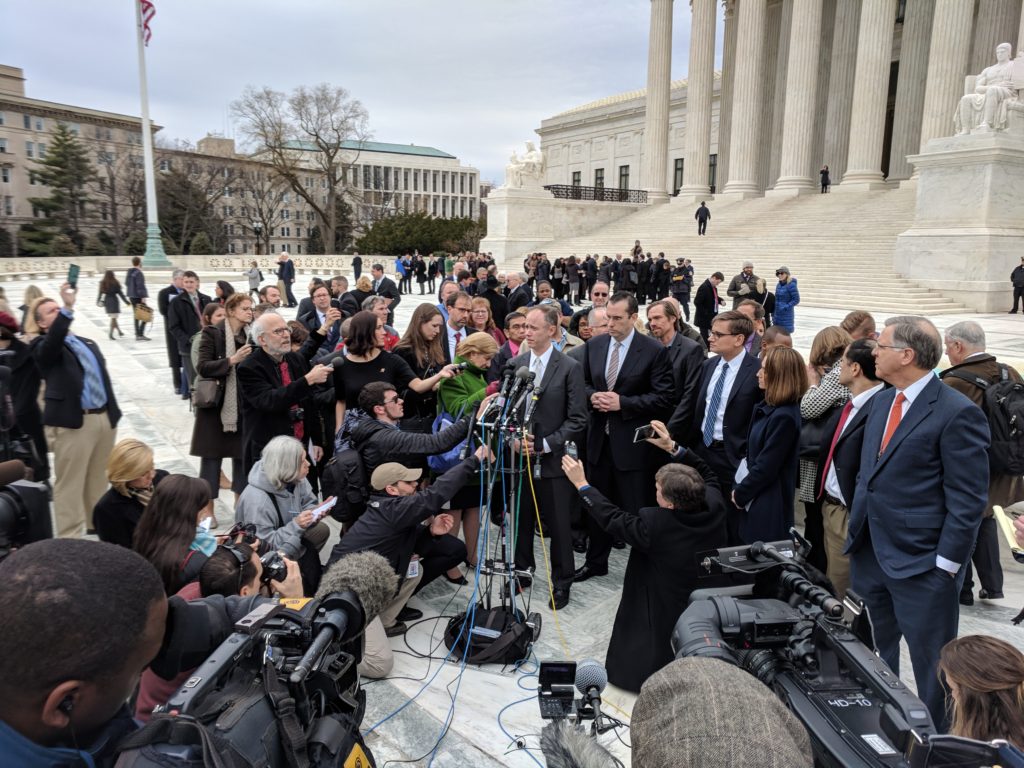
National Right to Work Foundation staff attorney William Messenger takes questions from reporters after arguing the Janus case on February 26, 2018
WASHINGTON, D.C. (June 27, 2018) – In a major victory for First Amendment rights, the U.S. Supreme Court ruled today in Janus v. AFSCME that non-union government workers cannot be required to pay union fees as a condition of working in public service. This landmark case restores the First Amendment rights of free speech and freedom of association to more than 5 million public school teachers, first responders and other government workers across the country.
Mark Janus, plaintiff in the case and a child support specialist for state government in Illinois offered the following reaction: “I’m thrilled that the Supreme Court has restored not only my First Amendment rights, but the rights of millions of other government workers across the country. Across the country, so many of us have been forced to pay for political speech and policy positions with which we disagree, just so we can keep our jobs. This is a victory for all of us. The right to say ‘no’ to a union is just as important as the right to say ‘yes.’ Finally our rights have been restored.”
Janus filed his case in Illinois in 2015 with free legal aid from the Illinois-based Liberty Justice Center and the National Right to Work Legal Defense Foundation.
Jacob Huebert, Janus’ attorney from the Liberty Justice Center, responded to today’s ruling: “This is the biggest victory for workers’ rights in a generation. The First Amendment guarantees each of us, as individuals, the right to choose which groups we will and won’t support with our money. Today the Supreme Court recognized that no one should be forced to give up that right just to be allowed to work in government. The Court recognized that unions have the right to organize and to advocate for the policies they believe in – but they don’t have a special right to force people to pay for their lobbying. They have to play by the same rules as everyone else.”
Mark Mix, president of the National Right to Work Legal Defense Foundation, offered the following comment:
“Today’s decision is a landmark victory for rights of public-sector employees coast-to-coast that will free millions of teachers, police officers, firefighters and other public employees from mandatory union payments. While this victory represents a massive step forward in the fight to protect American workers from forced unionism, that fight is far from over. Union officials and their allies in state government have already taken steps to prevent workers from exercising their rights under the Janus decision, while millions of private sector workers in states without Right to Work protections are still forced to pay union fees or else be fired. Further, workers of all stripes continue to have their freedoms of association violated by being forced under union monopoly ‘representation’ against their will. So while we celebrate today’s decision, there remains much work to do to both enforce and expand upon this historic victory over coercive unionism.”
Background: The Supreme Court heard oral arguments in Janus v. AFSCME on Feb. 26, 2018. On the day of oral arguments, a large crowd of public school teachers, other government workers and supporters from across the country rallied outside the Supreme Court on Janus’ behalf, calling on the court to “Stand with Mark” and “Stand With Workers.”
Illinois is among 22 states that has required many government workers to pay union fees as a condition of employment. Plaintiff Mark Janus has worked for state government in Illinois as a child support specialist since 2007. Over the past decade, he was forced to pay thousands of dollars in union fees to the American Federation of State, County and Municipal Employees (AFSCME) – even though he opposes many of the union’s positions on public policy issues, felt he would be better off without the union’s so-called representation and was never asked if he wanted to be covered by a union contract. Now that the Supreme Court has ruled in his favor, Janus will not be required to pay these union fees.
The fight over non-member union fees intensified in Illinois in 2015, when Gov. Bruce Rauner filed a lawsuit asking a federal judge in Chicago to declare non-member union fees unconstitutional. Lower courts ruled that the governor did not have standing to bring this suit because he personally was not required to pay union fees. That’s when state worker Mark Janus intervened in the lawsuit with the help of the Liberty Justice Center and National Right to Work Legal Defense Foundation. The case was renamed Janus v. AFSCME, and Janus was successful in taking this fight all the way to the highest court in the nation.
More information about the case is available at www.nrtw.org/janus.
Disney and UPS Workers Win Labor Board Decision Against Teamsters Union for “Repeatedly and Deliberately” Violating Their Rights
Washington, D.C. (June 22, 2018) – In a decision issued Wednesday, the National Labor Relations Board has found that Teamsters union officials violated workers’ rights by “repeatedly and deliberately” failing to honor the workers’ requests that deduction of union dues from their wages stop. The ruling affects thousands of workers whose rights were similarly violated by Teamsters officials.
The case was brought by several employees at Walt Disney World and United Parcel Service (UPS) in Florida. These workers each resigned from their membership in Teamsters Local 385 and revoked their authorization for union officials to charge dues.
However, Teamsters Local 385 union officials ignored the workers’ requests to stop collecting dues. Instead, union officials delayed months, until the window periods for withdrawing dues deduction authorization had expired, before responding that the workers had to continue to pay dues until the next window period.
The workers sought free legal aid from the National Right to Work Legal Defense Foundation in filing charges. The NLRB has ruled that Teamsters Local 385 officials violated the employees’ rights by failing to honor their requests to resign membership and stop paying union dues, and ordered the union to refund the union dues that were illegally charged during the period the Teamsters had ignored the workers’ requests.
Moreover, the Board majority recognized that the workers who were affected by the union officials’ practice of delaying action on requests to stop dues deductions “number in the thousands and are spread across central Florida.” Consequently, Teamsters Local 385 was ordered to notify all represented Disney and UPS employees of the Board’s decision by mail as well as by a posted notice.
National Right to Work Foundation Vice President Patrick Semmens issued the following statement about today’s decision:
“This ruling is an important victory for workers over scofflaw Teamsters officials who, as the Board found, repeatedly and deliberately violated the rights of the very workers they purport to ‘represent.’ Despite what union bosses may wish, federal labor law permits workers to resign from union membership and Florida’s Right to Work law means that workers in the state have the right to cut off financial support for a union completely. That the Board majority agreed with the Administrative Law Judge that the union be required to notify the thousands of affected employees through a mailing, rather than just a notice posting, is further evidence of the widespread infringement of workers’ rights by these Teamsters officials.
To read about other cases in which Teamsters Local 385 union officials ignored requests to withdraw union membership and cease paying union dues until the workers turned to Foundation staff attorneys for free legal aid, see the following Foundation news releases:
- Walt Disney World Employees Win Ruling Against Teamsters Union for Illegally Blocking Workers from Resigning
- Teamster Union Faces Another Federal Charge for Violating a Disney Company Driver’s Rights
- Disney Company Driver Files Federal Charge Against Teamsters Union Officials for Ignoring His Rights
Workers File Brief with Kentucky Supreme Court to Defend Right to Work Law from Union Boss Lawsuit
National Right to Work Foundation attorneys represent pro-Right to Work Kentucky employees who are opposed to forced union dues
Frankfort, KY (June 18, 2018) – On behalf of three of Kentucky workers, National Right to Work Legal Defense Foundation staff attorneys have submitted a brief in the ongoing union boss legal challenge to Kentucky’s popular new Right to Work law.
Kentucky governor Matt Bevin signed the state’s Right to Work provisions into law on January 7, 2017, making Kentucky the nation’s 27th Right to Work state to protect workers from being forced to fund a labor union as a condition of employment. Under Right to Work, union membership and dues payment are strictly voluntary.
The Kentucky workers, with free legal aid from National Right to Work Foundation staff attorney William Messenger, won a motion to intervene in the case brought by union officials against the Commonwealth of Kentucky. Although the Commonwealth is also defending the law, the workers’ rights are at stake in the case because without Right to Work they could be forced to pay union fees against their will.
A Circuit Court dismissed the union officials’ challenge in January. The Kentucky Supreme Court decided to take the case earlier this year and is scheduled to hear arguments in the case on August 10.
The brief filed recently by pro-Right to Work Bluegrass State workers urges the court to uphold the lower court’s dismissal of the case and end Big Labor’s baseless challenge to the state’s Right to Work protections for workers.
“Right to Work laws have long been upheld by appellate courts, including the U.S. Supreme Court. Union bosses’ arguments against Kentucky’s Right to Work law were rejected in the past and should be rejected again by the Kentucky Supreme Court,” said Mark Mix, president of the National Right to Work Foundation.
“Not only has Kentucky’s Right to Work law ensured that Bluegrass State workers have the right to choose whether or not to fund a labor union with their hard-earned money, but the state has benefited from record investment and job creation due to the law’s passage,” continued Mix. “It’s shameful that Kentucky union bosses want to undo all that, just to restore their power to have a worker fired for refusing to pay them a portion of their paycheck.”
National Right to Work Foundation Releases Statement on Hawaii Workers’ Victory at D.C. Circuit Court of Appeals
Washington, D.C. (June 15, 2018) – Today a unanimous panel of the United States Court of Appeals for the D.C. Circuit rejected the Obama National Labor Relations Board’s (NLRB) opinion that union officials’ forced dues threats did not violate the rights of Hawaii hotel workers.
The case was brought by several nonmember employees at Hyatt Regency Hotel in Hawaii who received a letter from union officials demanding payment of dues for which the union had no legal claim, and threating that failure to pay would result in the money being deducted from future paychecks. In fact, the union did have the money illegally deducted.
The workers filed unfair labor practice charges with free legal aid from the National Right to Work Legal Defense Foundation. After the Obama NLRB asserted that the union’s demand letter was a “mistake” and therefore not illegal, Foundation staff attorneys appealed to the D.C. Circuit Court of Appeals and argued the case before a three judge panel.
Today, the D.C. Circuit Court of Appeals strongly rejected the NLRB’s decision as “legally unsupportable” and remanded the case back to the NLRB with orders to reconsider the decision.
National Right to Work Foundation Vice President Patrick Semmens issued the following statement about today’s decision:
“This is an important victory against the type of coercion that independent-minded employees are all too frequently subjected to by union bosses. While it’s unfortunate that it has taken so long, we are pleased that these Foundation-aided workers are now a step closer to getting justice that the Obama Labor Board attempted to deny them.”
“The total rejection by this unanimous Appeals Court panel of NLRB Member Pearce’s majority opinion that defended blatantly unlawful union demands for payment is evidence of just how radical the Obama NLRB was when it came to allowing union officials to trample the rights of workers who don’t want to associate with a union.”
Hospital Employees Hit SEIU Union with Charges for Requirement to Renew Objections to Funding Union Politics
SEIU officials violate workers’ rights by demanding that non-members annually object to full union dues and by charging for organizing expenditures
Seattle, Washington (June 13, 2018) – Hospital employees at Kaiser Permanente filed federal unfair labor practice charges against the Service Employees International Union (SEIU) 1199 NW stating that union officials are violating their right to refrain from paying for union political activity. The charges were filed with free legal aid from National Right to Work Legal Defense Foundation and Freedom Foundation attorneys.
Sarina Forbes and Susan Rahn filed their charges with the National Labor Relations Board (NLRB) Region 19 office in Seattle. The charges state that SEIU officials are unlawfully requiring them to annually renew their objections to paying full union dues and illegally demanding forced dues for activities that cannot legally be charged.
Neither Forbes nor Rahn is an SEIU member. Because Washington lacks a Right to Work law, non-members can be required to pay some fees to union officials as a condition of employment. However, workers cannot be required to fund activities unrelated to union bargaining, such as political action, lobbying, or organizing.
Forbes and Rahn exercised their right to object to paying full union dues and funding union activities beyond what can be legally demanded. However, SEIU union officials require them to annually renew their objections. Under the scheme, if workers do not annually renew their objections, the union reverts to seizing full dues.
In their charges, Forbes and Rahn also claim that SEIU is illegally charging non-members for organizing expenditures, including organizing employees in other bargaining units and industries.
To protect their rights, Forbes and Rahn turned to the National Right to Work Legal Defense Foundation and the Freedom Foundation for free legal representation. The NLRB will now investigate the charges.
Two National Right to Work Foundation-won Supreme Court decisions (Ellis in 1984 and Beck in 1988) provide some limited protection by holding that workers cannot be forced to pay union dues for certain union activity, including organizing. Further, in several cases the NLRB has ruled it unlawful for union officials to require non-members to annually renew their objections to paying full union dues.
“Forbes and Rahn both chose to hold SEIU officials accountable for their illegal demands on their hard-earned money, but stronger legal protections are critical for the future of Washington’s independent-minded workers,” commented National Right to Work Foundation President Mark Mix. “Union bosses incessantly abuse their forced-fees privileges at the expense of the employees they claim to represent. This case underscores the need for Washington to pass a Right to Work law making union affiliation and financial support completely voluntary.”
Wisconsin Mill Worker Asks Labor Board General Counsel to Prosecute Steelworkers Union for Rule Blocking Dues Revocation
Union officials’ arbitrary rule forces workers to wait 13-months to cut off dues payments and exercise rights under Wisconsin Right to Work law
Washington, D.C. (June 12, 2018) – An employee of a Wisconsin paper mill has filed an appeal with the National Labor Relations Board (NLRB) General Counsel with free legal aid by National Right to Work Legal Defense Foundation staff attorneys. The filing asks the NLRB’s top prosecutor to review a decision by an NLRB regional office, which declined to bring charges against a local union whose policy makes workers wait up to 13 months before they can revoke their dues authorization and exercise their rights under Wisconsin’s popular Right to Work law.
Since 2015, Wisconsin’s Right to Work protections make union membership and financial support strictly voluntary. However, union officials blocked workers from exercising their rights under the law. Donald Dillabough, an employee at Clearwater Paper Corporation, found this out when he attempted to exercise his right to end payments to the United Steelworkers (USW).
In December 2017, Dillabough emailed the USW resigning from the union and revoking his authorization for the union to collect dues payments from his paychecks. Despite his revocation, USW union officials denied his request to end payments by claiming his request was not submitted during a union-created “window period.” The union had established an arbitrary 13-month waiting period in between windows in which employees can withdraw their membership.
In February, represented by National Right to Work Foundation staff attorneys, Mr. Dillabough filed an unfair labor practice charge against the union contending that the 13-month window period rule violates his rights under the National Labor Relations Act. However, the regional office declined to issue a complaint against the union. Now, Mr. Dillabough has appealed to the NLRB’s General Counsel, Peter Robb, who can overturn the decision not to prosecute the USW local for the union’s policy.
“Even in states like Wisconsin, where union dues payments are by law supposed to be completely voluntary, union bosses frequently employ window period schemes in an attempt to trap workers into paying forced dues against their will,” said National Right to Work Foundation President Mark Mix. “Wisconsin’s Right to Work law protects an employee’s right to choose whether or not to join and financially support a union. In their zeal to seize forced dues for as long as possible, USW union officials have violated longstanding Labor Board precedent, and the General Counsel should defend Mr. Dillabough’s rights by initiating a prosecution against the USW for this illegal policy.”
National Right to Work Foundation Attorneys File Brief in Case Defending West Virginia Right to Work Law
Brief counters union lawyers’ claims that invalid injunction let them extend forced dues contracts after law went into effect
Charleston, WV (June 7, 2018) – National Right to Work Legal Defense Foundation staff attorneys filed an amicus curiae brief with the Kanawha County Circuit Court. The brief urges the court to deny a motion made by union officials that would circumvent and undermine the protections afforded to workers by West Virginia’s Right to Work law.
The brief, filed in West Virginia AFL-CIO et al. v. Governor James C. Justice, et al. responds to union lawyers’ legally dubious arguments that union officials should be allowed to enforce forced dues contracts entered into during the pendency of an erroneous injunction against enforcing the state’s Right to Work law.
After West Virginia’s Right to Work law passed in February 2016, several state unions brought a lawsuit against the state. The Kanawha County Circuit Court issued a preliminary injunction against the law to prevent it from being enforced. However, the West Virginia Supreme Court later ruled that the Circuit Court was wrong to have granted the injunction in the first place.
The Right to Work law renders invalid all forced unionism clauses in union bargaining agreements entered into after July 1, 2016. After the injunction was dissolved, union lawyers asked the Circuit Court to exercise authority and give legal effect to such clauses in agreements entered into during the erroneous injunction’s pendency.
In the brief, Foundation staff attorneys argue that the Circuit Court cannot rewrite the date of the law’s application, allowing for workers to be forced to fund a union or be fired for years after the state’s legislature intended the law to go into effect.
Additionally, because the injunction was erroneous and is now dissolved, the Right to Work law is fully effective. Foundation attorneys argue that a wrongly-issued preliminary injunction does not give union officials any exemption to the law. The brief also explains that the Circuit Court’s validation of the clauses would decide the validity of an untold number of contracts in other jurisdictions throughout West Virginia concerning parties not even represented in the case, and therefore such an order would not be in the Circuit Court’s power.
“This lawsuit challenging West Virginia’s Right to Work law was always about creating confusion and uncertainty that union bosses could then exploit to seize more dues from workers against their will,” said National Right to Work President Mark Mix. “West Virginia’s popular new Right to Work law is a victory for workplace freedom, and it is long past time that Mountain State union bosses stop wasting dues money fighting dead-end legal challenges and start to work to provide services for which rank-and-file workers will voluntarily pay.”
Monte Carlo Bartender Wins Appeal After Losing Job Due to Collusive Deal to Force Her to Pay Union Officials for “Pour Card”
Labor Board General Counsel gives OK to investigate and prosecute UNITE HERE union officials’ scheme that discriminates against non-union members
Las Vegas, NV (May 30, 2018) – The National Labor Relations Board (NLRB) has sustained an appeal by a Las Vegas bartender who filed charges for being fired as a result of a collusive agreement between her employer and the local union. Natalie Ruisi filed the charges and appealed with free legal aid from National Right to Work Foundation staff attorneys.
Ruisi worked at Aramark Sports and Entertainment Services, a subcontractor for Monte Carlo Hotel and Casino. She, as well as several other Aramark employees, was discharged because she did not meet Monte Carlo’s requirement to pass a craft examination offered solely through the company union, Local Joint Executive Board of Las Vegas affiliated with UNITE HERE International (UNITE HERE).
Ruisi claims that the contract between Monte Carlo and UNITE HERE violates the National Labor Relations Act by requiring employees, including those who work for subcontractors, to take pre-hire classes from the union as a condition of employment. She alleges that the requirement unfairly discriminates and encourages membership in a labor organization.
In 2013, Monte Carlo and UNITE HERE entered into a monopoly bargaining agreement that her NLRB charges say illegally discriminated against workers who chose to exercise their right to refrain from formal union membership. The discrimination included requiring bartenders, even those who work for a subcontractor, to pass a craft examination that could only be obtained through union officials in order to acquire a “pour card” to work.
When Monte Carlo subcontracted to Aramark, UNITE HERE officials demanded that Monte Carlo discharge all Aramark employees who had not passed the union’s craft examination. Ruisi and 15 other employees, who as nonmembers did not know about the requirement until after they were hired, were discharged.
Although the NLRB Regional Director scheduled a trial with the intention of prosecuting the violation, at the last minute the charge was unexpectedly dismissed. Foundation staff attorneys appealed, and Trump-appointed NLRB General Counsel Peter Robb ruled that the Regional Director should investigate the case for violations of the National Labor Relations Act. The case has been remanded to the Regional Director for further action.
Nevada is a Right to Work state, with laws that protect individual workers’ rights to choose whether or not to join a union and pay union dues. Additionally, the National Labor Relations Act protects workers’ choice to refrain from union activities and prohibits employers from interfering with or coercing employees in violation of their rights.
“Ruisi is fighting for her right to choose whether or not to associate with a union – a right that, in addition to her rights under federal labor law, is codified and protected by Nevada’s Right to Work law,” commented National Right to Work Foundation President Mark Mix. “Unfortunately, this type of illegal union scheme is widespread in Las Vegas, which is why this successful appeal is so important.”
“Other Las Vegas service industry workers facing similar situations should know that they can contact the National Right to Work Foundation to request free legal assistance,” added Mix.
Nurse Files Federal Charges after Union Officials Harass Employees at Petition Table
NNOC union officials blocked access to informational table, pushed incomplete dues authorization forms, to obstruct petition to remove union
Kansas City, MO (May 25 2018) – With free legal aid from National Right to Work Foundation staff attorneys, a hospital worker has filed federal charges against a local union after officials harassed her and other employees as they attempted to gain signatures for a petition to remove the union.
Kacy Warner, a nurse at Research Medical Center, filed unfair labor practice charges with the National Labor Relations Board (NLRB) against the local National Nurses Organizing Committee (NNOC). In the charge, Warner states that union officials violated her and other employees’ right to choose their representative by their attempts to intimidate employees from approaching an information table about a decertification petition.
Warner is not a member of the union. She is circulating a petition to decertify the union, which if supported and voted for by a majority of workplace employees would remove the union from the workplace.
Warner and her colleagues set up an informational table in a reserved room, with the petition on the table for employees to sign. She and a fellow employee were then approached by the union’s chairman with two forms: a membership form and a nonmember form, both of which required her to authorize the union to siphon money from her paycheck.
The chairman demanded that Warner and her colleague sign one of the forms immediately. The demand was only made after Warner began circulating the petition.
As the situation continued to escalate, union officials began “loudly badgering” Warner and her colleagues as they tried to inform other employees about the petition. Officials blocked their table, sat in chairs on either side of the doorway, and intercepted employees who entered the room in efforts to squelch the decertification petition.
Unwilling to be intimidated into silence, Warner turned to the National Right to Work Foundation for free legal assistance in filing charges. The NLRB will now investigate.
Because Missouri’s Right to Work law is pending a voter referendum, employees can currently still be required to pay dues or fees to unions to keep their jobs, even if they are not union members. Under the Foundation-won 1988 U.S. Supreme Court Beck decision, the Court provided limited protection by stating that employees can only be forced to pay union dues for certain union activity, and that unions must justify the amount of the compulsory fee. The forms that the union chairman demanded Warner and her colleague sign failed to comply with those requirements.
Additionally, under certain parameters, employees have the right to hold a petition for decertification, which revokes the union’s “certification” to be the exclusive bargaining representative. If 30% or more of workplace employees sign the petition, the NLRB will hold a secret ballot to determine whether a majority of workers wish to decertify the union. If so, the union is effectively removed from the workplace.
“Union bosses are trying to cling to their power by taking away the voices of the workers they claim to represent,” said National Right to Work Foundation President Mark Mix. “Time and time again, union bosses display huge amounts of entitlement when they try to force fees from the hands of workers rather than earn workers’ voluntary support. Warner is doing the right thing by holding them accountable for their intimidation tactics. Workers will only be protected from the injustice of forced union dues after the citizens of Missouri put their Right to Work law into effect.”
Supreme Court Asked to Hear Case Seeking Return of Union Fees Seized in Scheme Invalidated in High Court’s 2014 Harris Decision
National Right to Work Foundation attorneys file brief for Illinois homecare providers who had $32 million seized by SEIU without their consent
Washington, DC (May 21, 2018) – Today staff attorneys from the National Right to Work Legal Defense Foundation filed the final brief in Riffey v. Rauner asking the United States Supreme Court to grant certiorari and hear the case. The home care providers for whom the case was brought had over $32 million in fees seized by union officials in a scheme the Supreme Court has already ruled violated the First Amendment. The case is now fully briefed and the Supreme Court could announce in June whether it will take the case.
The reply brief filed today counters the claims made in briefs by union officials and the Illinois Attorney General. Those briefs were filed only after the Supreme Court required the union and the attorney general to file briefs responding to Foundation attorneys’ initial petition for a writ of certiorari.
Riffey v. Rauner is a continuation of the Foundation-won Supreme Court Harris v. Quinn case. If the Court decides to hear Riffey, the Justices will consider whether a class of nonmember homecare providers should receive a refund of over $32 million that SEIU union officials seized from them without their consent.
Beginning with a 2003 executive order by former Illinois governor Rod Blagojevich, tens of thousands of individual homecare providers were classified as “public employees” solely so they could be unionized by the SEIU and thus required to pay union fees. Many of these in-home care givers were parents caring for their own children in their own homes.
Staff attorneys with the National Right to Work Foundation assisted eight of these providers in filing a federal class-action lawsuit, Harris v. Quinn, challenging the forced dues. In 2014, the Supreme Court ruled that SEIU’s forced dues scheme violated the First Amendment rights of the in-home care providers.
To settle remaining issues, the case was remanded to the District Court and re-designated as Riffey v. Rauner. The District Court ruled in 2016 that, even though the workers never consented to their money being taken for union fees, the SEIU did not have to refund the over $32 million in unconstitutional fees confiscated from union nonmembers.
Foundation attorneys are now asking the Court to take the case and determine whether the “government inflicts a First Amendment injury when it compels individuals to subsidize speech without their prior consent.” If the Court so rules, it would overturn the lower court’s reasoning denying the providers refunds of the seized fees.
Riffey is not the only case being litigated by Foundation staff attorneys related to whether individuals must take steps to “opt out” of dues the Supreme Court has already ruled they cannot be required to pay. In Hamidi v. SEIU, currently fully briefed at the U.S. Ninth Circuit Court of Appeals, a group of California state employee nonmembers are challenging a union requirement that they must take an additional step to “opt out” of union dues the union admits are used for lawfully non-chargeable political activity.
“Union bosses assume that they’re entitled to a significant cut of workers’ hard-earned money when they force nonmembers to leap through bureaucratic hoops just to stop funding activities they didn’t sign up to fund in the first place,” said National Right to Work Foundation President Mark Mix. “The Foundation will continue to fight for these homecare providers to get their illegally-seized money back.”
“If the Supreme Court agrees with the National Right to Work Foundation staff attorney who argued the Janus case heard earlier this term, challenges like Riffey and Hamidi will likely be the next big issue when it comes to fully protecting the constitutional rights of government employees from forced unionism,” added Mix. “Ultimately, the Supreme Court should make it clear that individuals who have never joined a union cannot be required to take affirmative steps just to protect their First Amendment rights.”





